Saturday, June 6, 2009

June 5, 2009 Friday, Evening


Wipeout Bar and Grill

World Ocean Day Celebration

6:00 pm to 9:00 pm

Surfrider Foundation Marin County


If you didn’t attend Surfrider Foundation Marin County’s celebration of World Ocean Day Friday June 5th, then you REALLY missed it.

Forty surfers, ocean enthusiasts, environmentalists, concerned citizens and lovers of Marin’s beaches crammed into the backroom of the Wipeout Bar and Grill in Greenbrae and braved the noise of a busy restaurant to hear about the meaning of World Ocean Day, surfing, the Plastic Vortex, water quality in Marin, the movement against desalination, Surfrider’s Rise Above Plastic program and surfing in the old days.

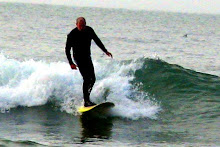
Guest speaker, Steve Hawk (pictured above), read his humorous article “Getting Drilled” about having his ear drilled out due to surfer’s ear, a condition where the ear canal closes down due to continual contact with cold water. A friend asked if he considered giving up surfing to preserve his hearing. “No way, get out of my house.” A true surfer would never give up surfing regardless of the price. Steve has made surfing his profession through writing. He was the editor of Surfer magazine from 1990 to 1999, executive director of the Swell.com website, author of the book Waves and numerous articles about surfing. He spoke of the changing landscape of publishing and it’s impact on surfing magazines. One company now owns both Surfer and Surfing magazines, thus they do not compete and both have a large presence on the Internet. The recession is taking its toll and advertising is down. Surfer has gone from 180 pages to 140. A different business model, which is working, is Surfer’s Journal that relies on hefty issue price ($12) instead of advertising.

George Orbelian, avid surfer, head of the San Francisco Global Trade Council, board member of the Farallones Marine Sanctuary, and executive team member of Project Kaisei, spoke about the “Gyre” (also known as the Plastic Vortex). The Gyre is an Ocean vortex northeast of Hawaii that due to ocean currents has been accumulating millions of tons of plastic waste in a mass the size of Texas that is killing marine life, growing bigger every day and impacting people’s health. Every piece of plastic ever made still exists because its molecular structure resists biodegradation. Over time plastics disintegrate into ever-smaller pieces due to weather and UV impact. The smaller particles resemble food and are becoming part of the zooplankton mass consumed by small fish at the bottom of the food chain. Smaller fish are eaten by bigger fish, and bigger fish are eaten by humans. Thus plastic, a carcinogen is becoming pervasive through out the entire food chain. George is an executive team member of Project Kaisei, a United Nations Environment Program. Beginning in the summer of 2009, Project Kaisei will examine the Gyre by making two swaths through the Plastic Vortex to study how to capture plastic waste and detoxify and recycle it into diesel fuel. Its mission is to understand the logistics needed for a successful clean-up operation. We will want to follow the progress of this important effort.

Mill Valley lawyer Kerry Stoebner spoke about the efforts of the newly formed Marin County Water Coalition, a group of civic groups of which Surfrider Marin is a member, to oppose Marin Municipal Water District’s proposed desalination plant. The negatives of desalination are numerous: uses nine times more energy than treatment of land water, requires continual operation regardless of needs, will flush untreated brine waste containing concentrations of harmful chemicals such as cyanide, ammonia, PCB’s and fire retardants back into the bay, will dump a toxic sludge into the overtaxed Redwood Landfill, is highly destructive of marine life by killing fish, fish larvae and marine mico-organisms in its in-take machinery, and extracts water from San Francisco Bay, a known “toxic hot spot.” The solution is aggressive water conservation. Through the sponsorship of Food and Water Watch, James Fryer, a water management and conservation expert and former head of conservation for MMWD, just published his eight month study, Sustaining Our Water Future – A Review of the Marin Municipal Water District’s Alternatives to Improve Water Supply Reliability. His report concludes that increased conservation, reduction in landscape irrigation, improvements in reservoir operations, reduction is system leaks, increased usage of efficient toilet and urinal retrofits and additional water recycling will supply more than the district’s projected water deficits. Kerry and other Coalition members had copies of James’ report for everybody to review.

Kathy Soave, head of the Science Department at the Branson School, marine biologist and avid surfer introduced Kevin McGovern and Will Harvey, Branson Students, who presented their World Ocean Day video. The video, which the was shown on the restaurant’s numerous video screens, discussed the origin and meaning of World Ocean Day and interviewed high school students about the importance of the world’s oceans. It was well done and well received by this ocean-loving crowd.

In the corner of the room sat a six-foot long, four-foot high a model of a tubular wave made of plastic bottles, the result of an eco-project by teacher Ann Brown and her students at the Neil Cummins school in Tiburon. With the help of Surfrider’s Michelle Slade, the students participated in Surfrider’s Rise Above Plastic Program that instructs about the destructive consequences of plastic to our environment. Ann, two of the wave builders and their parents were there to receive congrats from audience. Their wave will be in the Larkspur Fourth of July parade. Look for it.

I gave a brief talk on Surfrider Marin’s water testing program. Once a week two retirees who surf gather water samples at Bolinas and Stinson, drive them to Branson School where students under the guidance of environmental science teacher Jamie Brandt (who is also an avid surfer) test the quality of the water. Surfrider Marin provides the equipment and chemicals, the students carefully add the testing agent, incubate the solutions for 18 hours, measure the amount of bacteria and post the results on Surfrider’s Blue Water Task Force website. The process tests for enterococcus, bacteria found in human sewage. We in Marin are fortunate; our tests show that the ocean water quality is excellent.

The surprise of the evening was Fairfax resident John D’Amato showing up with freshly restored copies of his 1964 surf film, The Young Knights – A Hymn to Surfers. Wipeout’s manager Frank queued up John’s movie and we were treated to classic longboarding in Southern California (Hermosa, Manhattan Beach, County Line and Huntington Beach). As the film’s promo put it: Longboards only, short hair and no tattoos. Check out the film at John’s website – www.youngknightssurf.com.

Everybody had a great time, spirits were high and the enthusiasm to carry on the efforts to protect our precious oceans filled the room. Next time be there. Don’t miss it.

Check out my photos at:

http://gallery.me.com/lorenlmoore1#100068

Thursday, June 4, 2009

June 4, 2009 Thursday


Bolinas

Channel

7:40 am to 9:40 am

3' to 4', occasional 5'

High upcoming tide

No wind, occasional offshore breeze

High overcast

Fun session


After yesterday’s fun session and with the prediction of a building south swell I was determined to get out there early. The night before I got my surf gear ready and set the timer on the coffee pot for 5:30 am. The plan was to be on the road at 6:00 am. Alarm went off at 5:30 am, the coffee was ready; I loaded the car, filled my travel mug, brought Kate a cup of coffee and was out the door by 6:15 am. At Bolinas I chatted with Russ and Pete who were suiting up. I took some photos from the cliff above the Groin and was suiting up when Marty pulled in.

“Check your watch,” I said to a surprised Marty. This was the first time I ever beat him to the beach. I entered the water at 7:40 am. Not bad. This was the earliest I have been in years.

I was worried about the crowd. The only rideable peak was in the Channel and four surfers were on it when I took my photos. Doug and Jim had just headed for the beach, and Russ, Pete, Marty and I were suiting up. That would make ten surfers at one break. But luck prevailed. The four surfers ended their session; Doug, Jim, Russ and Pete paddled over to Seadrift and that left only Marty and I at the peak in the Channel. For a half-hour we had it to ourselves.

The waves were smaller and more infrequent than yesterday. I was disappointed. All the Internet sites were predicting the south swell to be building. But the set waves were good. Long power glide left waves like yesterday. Russ and Pete paddled back over from Seadrift. Thirty minutes later, Doug and Jim paddled over. Seadrift was walled and closing out, they reported, big slammers on the sand. Eight of us ended up at the one peak in the Channel, and as the tide came in the waves became more infrequent. With patience we sat through the long lulls and waited for the good sets waves. We were a mellow bunch and enjoyed sharing the waves.

After two hours my arms were giving out, and despite 55-degree water, which is warm for Bolinas, I was cold. I finally caught a good one that took me near the shore and decided to go in instead of making the long paddle back out. My hands we so cold and numb I had trouble turning the key in the lock and had difficulty pulling off my booties and wetsuit. When the hands become numb they loose strength to grip anything.

Professor Steve showed up in his newly detailed old Volvo.

“Wow! Is that a new car?” exclaimed Marty.

The usual crust of five years of dust, dirt, mud and junk had been removed. The old surfboard racks were gone. The silver gleam had returned and the tires were a shinny Armoural black. Steve had received a two-for-one offer from a detailing shop in San Rafael. We couldn’t believe the difference and we gave him a boatload of grief about it.

Today was the second day of the good south swell, we were on it and appreciated it.

Wednesday, June 3, 2009

June 3, 2009 Wednesday


Bolinas

Channel

9:00 am to 10:30 am

Consistent 3', sets to 4'

High tide (3.9 feet)

North cross breeze

Patchy high clouds, some light rain

Fun session


Today was a pleasant surprise, the weather changed and the south swell arrived. A low-pressure system had moved in and pushed out the June Gloom that had been plaguing us for the last month. A light rain fell on me in Mill Valley as I loaded my board into the car, it cleared up by the time I reached Bolinas and high patchy clouds with on and off sunshine came out. A light offshore/cross breeze put a light ripple on the surface of the water.

My surf expectations were low, but this morning the NOAA weather radio reported a three-foot 14-second swell giving me a glimmer of hope. “Maybe the south swell has arrived early,” I said to myself. Stormsurf has been announcing Swell #2S, meaning the second major south swell of the season, for a week, predicting first remnants arriving Wednesday (1.6 feet at 15 seconds), growing on Thursday to 2.0 feet at 14 seconds, raising more on Friday at 2.3 feet at 17 seconds and peaking on Saturday at 2.6 feet at 16 seconds.

At Bolinas, Mary, Marty, Russ, Dan and Pete were out at the Channel when I arrived. From the seawall I saw them at a beautiful three-foot peak in the middle of the Channel. A peak that broke continuously, without sectioning, in both directions a long ways. The south swell had arrived and it was going to be a good session. The peak consistently broke in the same spot, the initial break was the steepest and fastest part of the wave, after the first break the waves slowed down but continued breaking for a long, long ways. Marty and Mary connected on two long lefts and then had to make the long paddle back out. The above photo is Mary on a good one. After the wave drought for the whole month of May, these waves looked great to me. I was excited.

Back at the cars, Russ and Pete were changing after their session. They were hyped up. I got that, “where were you? It was great earlier.” Russ was in the water at 7:00 am. He even beat Mary out. At lower tide the waves were steeper and faster. The patchy sky and early morning light rain produced a spectacular setting for some great rides. “Loren, tomorrow you have to be here early,” Russ insisted.

“Mary, where’s the take-off spot?” I asked Mary after making the long paddle out to the peak.

“I have been just watching the white water,” she said. “I can’t believe how good these waves are. What a change from yesterday.” Marty also comment on the change and the beauty of the waves.

“What’s better? The lefts or the rights?” I asked.

“The lefts, definitely,” Mary answered. I caught two waves one left and one right and knew Mary was correct. The rights were breaking into deep water and died after they broke.

After riding a few my strategy was set: sit way outside and wait for the set waves, move to catch the exact center of the peak, and paddle hard to gain board speed to get into the waves early. After the initial break, the momentum of the waves significantly dropped. The take-offs were best part of the ride, thus getting into the waves early was important. On my first good left, I stroked into a four-foot peak, turned left, looked down a well-formed wall of water, leaned into the wave to climb to the top of the swell, coasted down a good section, turned back into the breaking part of the wave, let the wave build up again and turned back onto the shoulder and coasted through another section. What a good ride and it was long. The paddle back out took a while. The rides were smooth: coast down a section, make a swooping turn back into the white water, turn back into swell, cut-back, swoop back into the swell again, and repeat these maneuvers three more times until the wave ran out of gas. The surface had a small wind ripple that cause the board to make a chatter sound when cruising down the first section. The sound was similar to that a small sail boat makes when tacking at four knots across a smooth yet textured surface. These were classic “power-glide” waves similar to those at Waikiki, or San Onofre, Bluff Cove in Palos Verdes, the reef at Cardiff by the Sea or the Patch on a good day.

We all were elated after our sessions. I considered staying out another hour or so, but I knew the swell was building and tomorrow could be even better. I should save my arms for tomorrow. A good one came through, I stroked into it, cruised high in the curl, turned back into the breaking part of the wave, turned back onto the shoulder and on and on and on I went. I was getting close to shore, so this was it; I milked the wave for as long as I could. I ended up inside the Groin pole and about 50 yards south of it. That was it. I was going to save my remaining strength for tomorrow. While walking back to the car, I mentioned to Marty that I might be making a classic surfer mistake. In surfing, if there are waves, you surf. You never know what tomorrow will bring. We’ll see.

Friday, May 29, 2009

May 29, 2009 Friday


Pacifica

Linda Mar

9:00 am to 10:30 am

1' to 2', sets to 2.5'

Low tide

Stiff offshore - cross breeze

Patchy high clouds, fog on the ridge

Exercise - fun session


Marty and I were having a coffee on the deck at Taco Bell after our “exercise session” at Linda Mar. This Taco Bell has a fabulous location, right on the sand overlooking the beach and break at Linda Mar. Three young women arrived all in wetsuits, one carrying a soft-top surfboard, one sitting in a wheelchair and the other pushing the chair. Two of them had to lift the wheelchair with occupant over the small rocks on the edge of the beach. This was not a normal wheelchair, but one used in wheelchair races with three wheels: two balloon bicycle tires in the rear, and one small wheel in the front. They pushed their handicapped friend to the water’s edge, lifted her out of the chair and set her on the surfboard. One also climbed onto the board and the two of them stroked out to the tiny waves tandem style.

The handicapped woman was paralyzed from the waist down and had limited movement in her arms. Her companion managed quite well maneuvering the board. They paddled back and forth for exercise and then straightened out to catch a wave. The waves were small and they caught some white water, rode it up to the sand, fell off, and frolicked in the shallow water. They took pictures of themselves sitting in the water. All three had a great time. This had to be the best therapy for the one confined to a chair. The surf movie Step Into Liquid had a similar sequence. Rob Machado took his life long friend, who was paralyzed due to a surfing accident, out surfing at Cardiff by the Sea. Rob pushed him into waves; his friend had enough upper body movement to position the board in the wave and to buzz down some steep curls. The guy loved it. As he joyfully stated, it was the best form of therapy.

The other sight Marty and I enjoyed from the deck of Taco Bell was the whales. Way out to sea we could see spouts of spray blown into the air by the surfacing whales. It was good to see them. I haven’t seen whales in years, but this year I saw whales close to shore at Stinson Beach (see April 16 posting) and now several were here at Linda Mar. When I arrived this morning I stood at the wall behind the showers to take some photos of the surf.

“Are you shooting surfers or whales?” a woman next to me asked.

“Surfers,” I replied.

“There are whales out there,” she said. “Watch, you can see their spray.” She was right. I spotted several of them within a few minutes.

“The whales are migrating north,” she continued. “The mothers bring their babies into this bay to rest. They rest here to build up stamina for the long migration north. They’re here also to avoid the orcas who will kill the babies.” I have no idea if what she said was true, but it made a good story to explain the appearance of the whales. All through our surf session and afterwards we observed the spouts of spray from the whales.

Why am I here in Pacifica? The surf prospects on the Internet were terrible: three-foot wind swell at seven seconds. The June Gloom had arrived early this year. Growing up in Southern California, the worst month for weather was always June when the fog, overcast and onshore winds arrived and hung around all month. This phenomenon, which we called the June Gloom, occurred along the entire coast of California. But this year it has arrived early: fog, no swell and cold south winds causing the worst May for surf I have seen in years. But yesterday Marty sent out an email glowing about the 3’ to 5’ waves at Linda Mar, good rides, offshore breeze, sunshine and a friendly crowd. He invited all of us to join him tomorrow. Why not? South winds ruin Bolinas and Stinson, but they create good conditions at Linda Mar, a north facing beach.

I awoke this morning to fog and wind in Mill Valley. Crossing the Golden Gate Bridge, I saw white caps from the bridge out to the horizon. The flags at the toll plaza were straight out from onshore winds. Why am I doing this? At Ocean Beach conditions were better, the south cross winds didn’t impact the shape of the waves, but there was no swell.

At Linda Mar conditions were decent. This was the only spot where the waves were rideable. Offshore winds held up the small curls. Six surfers were at the one and only peak along the entire cove. Marty was one of them, thus I decided to join in. The peak formed over a sandbar and the lefts broke into a deep channel. Well-shaped promising waves would die once one reached the channel. I took several of them expecting the curl to build up again on the inside. They never did. After an hour I finally realized that the rights were breaking into shallow water and had much better form. The peak was consistent; it broke straight out from a pole of a volleyball court. This became my marker. The strong south wind was blowing us north. I would sit outside and within a few minutes would have drifted a 50 yards north and be in the middle of the channel where the waves didn’t break. Marty and I were constantly paddling south to align with the pole. By moving south and concentrating on the rights I connected with four small decent curls within a ten-minute time span.

I mentioned to Marty it was time to go in. “Why?” he asked. “We’re having fun and there’s no crowd.” Well that changed quickly. At 10:00 am several more surfers came out. It was like a shift change, and all of them bunched with us at the only peak. Then we knew it was time to go in.

Despite the small waves, Marty and I agreed it was a fun session, good exercise, warm water, and beautiful sights with physical water therapy and migrating whales.

Thursday, May 14, 2009

May 14, 2009 Thursday


Bolinas

Channel

8:50 am to 10:15 am

6 inches to 1', sets to 2'

Low tide

Offshore wind

Heat wave, sunny and warm

Exercise only session


“If the swell was two feet bigger, the waves would be perfect,” I said to a young surfer out at the Channel this morning. We were the only two out.

“These waves remind me of Lake Michigan,” he replied.

“You have surfed Lake Michigan?”

“Yes,” he said. “I grew up in Chicago. Only when there’s wind are there waves.” He mentioned choppy conditions, cold water and snow on the beach. To him, these six-inch waves at the Channel were good.

I had no expectations this morning, only hopes. “No swell of interest” was Stormsurf’s prediction. Low tide and no swell, what was I thinking? An email from Marty yesterday mentioned several people had gone out, got some fun waves and that he was coming today. The parking lot was empty when I arrived, no Marty and no others. From the Seawall the Patch was flat and the reef was exposed. The only waves were ripples breaking in the Channel where the out flowing ebb tide met the ocean.

The sand was back. The Groin wall was completely buried. Only a couple of months ago the top of the wall was four feet above the sand. A finger of sand extended from the Groin pole out 75 yards along the edge of the Channel. The out-flowing current was a good four knots. I walked out to the end of the sand bar to observe perfect lefts, six inch ripples peeling continuously along the contour of the finger of sand.

“The bottom is shaping up for some ideal lefts,” I thought to myself. “If we only had some swell, it would be perfect.”

I stood there for several minutes and observed two sets of two-foot waves, perfect little curls being held up by the offshore wind. I’m the king of the knee-high curl; I could ride those waves. Thus I decided to give them a try.

The waves were too small even for me. On my first wave, the curl was breaking several feet ahead of me by the time I stood up. The water was clear and shallow; I could see all the ripples of sand on the bottom. One second of riding the white water my skeg dug into the bottom and I executed a perfect spread eagle belly flop into six inches of water. I floundered around on several waves without any success. My Chicago companion didn’t do any better. We moved to mid-Channel but the out-flowing current and strong offshore wind coming out of the canyon above the lagoon pushed us out beyond the breaking waves. We moved back and continued to flounder. On my two best rides I belly-boarded them. I stroked into these curls and remained laying down not to lose time or momentum by standing up. With my eyes at board level I caught a glimpse of a curl ride.

During the long lulls I soaked up the incredible scenery of the day. The birds were out: high cruising pelicans, squadrons of cormorants, and terns hovering in search of fish. Three vultures circled overhead. “They’re land birds,” I thought to myself. “If they drop into the water they will never be able to take off.” The strong offshore wind was pushing them out to sea.

After an hour we both gave up. To get some exercise I started paddling from mid-Channel to the Ramp. Halfway there I met Professor Steve paddling in the other direction. He was out for his morning exercise.

“We’re like two ships passing in the night,” he greeted me.

“I’m just following your lead to get some exercise,” I said. He agreed that the finger sandbar was set to produce some perfect lefts. If we would only get some swell.

A surfer never admits he wasted his time. I got wet, it was a beautiful morning and I got some good exercise.

Friday, May 8, 2009

May 8, 2009 Friday


Bolinas

Channel

8:45 am to 10:45 am

2' to 3', sets to 3.5'

Low upcoming tide

No wind

Bright, sunny and warm

So - so session


The weather had changed again: Wednesday was overcast and drizzling, yesterday the sun came out and today it was hot, heat wave conditions. A high-pressure front engulfed the entire coast of California. Hot dry Santana winds blew down the canyons of Santa Barbara touching off another horrible brush fire destroying one hundred homes. At Bolinas, the warm sunshine was a relief. The comfortably hot weather and blue-green knee-high curls were enough to entice me out into the water.

“It’s such a beautiful day,” I said to Matt when we checked out the waves from the seawall at the base of the Ramp. “We have to go.” Matt agreed. Mary and another surfer were at the Channel catching small left curls. Doug, Jim, Marty and a couple others were at Seadrift out in front of the tenth house. They were so far down the beach I could not tell if they were catching any decent rides. The lefts Mary was catching looked like fun, plus the tide was out far enough that one could walk out to the waves. With the tide coming in, Matt and I were optimistic that conditions would improve.

The waves were small, gentle and tricky to catch. They peaked at one narrow point and you had to be at that point to catch them. I had no success trying to catch shoulders, only at the apex could I obtain enough drop and speed to push into the waves, and with luck they would build up on the inside to provide a long ride. The opposite often happened also; I would drop down the peak, turn and the wave would die. After a half hour my strategy was set: sit outside to catch the peak, look for swells that stretched across the impact zone and take off late. The peak moved around but it was more or less mid-Channel. Swells that stretch across the impact zone had more energy and would tend to build up on the inside to provide long rides. Late take-offs provided the steep drops and momentum to continue in the swell while it built up on the inside. The strategy worked and I caught several waves, both lefts and rights. At first the rights were best and then a half hour later conditions changed and the lefts were better. These were gentle slow waves, the initial drops and turns had speed but I had to immediately cut back into the breaking part of the waves to stay in them. Often the waves would rebuild and I would coast down the inside mellow curls.

Several of the regulars were out today enjoying the warm weather. Mary stayed out for three hours and had a great time. Russian River Cathy was there on her ten-foot tanker catching wave after wave. Matt stayed inside and concentrated on the rights. Mark the archaeologist was right there with me at the peak. Professor Steve came out later and went for the small waves at the Groin. Walt the photographer arrived on his standup board; he stroked into one gentle swell after another. As the waves built up he would drag his paddle in the face of the swell to turn the board and then paddle while cruising along to build speed. After an hour, Doug, Marty and Jim paddled over from Seadrift to join the rest of us. Seadrift was good when they started but died as the tide came in. All three of them logged three hours in the water this morning. Last week I ripped the shoulder panel my wetsuit and was trying to convince myself that the hole wasn’t so bad. Water was pouring down the body of my suit and filling in the leg areas. After two hours I was freezing, yes the hole was bad, I have to get it fixed. With numb hands I paddled in.

Back at the cars, all of us were praising the warm weather, the beautiful ocean and the classic small waves. Wave prospects for next week don’t look good, thus we were glad we caught this morning’s modest offerings.

Wednesday, May 6, 2009

May 6, 2009 Wednesday


Bolinas

Patch

9:30 am to 10:45 am

3' to 4', sets head high

Mid upcoming tide

Slight onshore breeze

Overcast with drizzle

Fun session


I hadn’t surfed in nine days and was hungry for some waves thus my expectations were high even though the predictions on the Internet were fair at best: 8 foot NW swell at 14 seconds, 8 knot wind out of the west and water temperature at 53 degrees. At least the water temp had come back up. My last session on Monday April 27th in small waves at Seadrift was cold and windy, water temp at 46 degrees and a howling NW wind. Marty and I froze. Since then another storm front has come through Marin bringing two inches of rain and south winds. The weather was breaking today and we’re coming into a period of warm weather. I had started reading a new book on surfing, The Big Drop, edited by John Long, a collection of 32 true stories about big wave surfing. After reading tales about Greg Noll, Jose Angel, Buzzy Trent and Jeff Hakman, fearless adventurers who were willing to launch themselves into scary mountains of water at Waimea, Pipeline and Makaha, I was psyched up for anything that Bolinas could throw at me.

The sun was shining as I left Mill Valley, the cloud cover appeared at Mountain Home and the drizzle started at Pan Toll. “I’ll drop below the clouds on the other side”, I said to myself. Not so. The drizzle became more pronounced as I approached Bolinas. I saw white water all along the Duxbury reef, far out from the point at Bolinas, a good sign that a swell was running. Several cars were parked at Brighton Ave including Mary’s, Marty’s, Doug’s and Russ’s and their boards were gone, another good sign.

The drizzle was now a light rain, nothing was dry and water was running down the street. I kept my camera in my backpack to keep it dry as long as possible, walked down to the seawall, saw Doug and Jim going for walls straight out from the Ramp and noted that Mary, Marty and a couple others were out at the Patch catching some decent rights. There were two out at the Channel but it didn’t look good. I’ll head for the Patch.

Russ came in as I was suiting up and reported that it was much better earlier and now the high tide was causing the waves to go flat. Just my luck. Doug and Jim who had ended their session stated that it wasn’t any good; the waves were small, shapeless walls. Another guy had just come in. I asked him how it was. Good an hour ago, now the flood tide was killing the waves. Again, just my luck.

“I heard I’m an hour late,” I said to Mary when I paddled out to the line up at the Patch.

“No, you’re not,” she said. “There are still some good waves coming through.”

She was right. There was a decent yet bumpy swell running with a sizeable peak that would rebuild into a long, fast, right wave. I watched Mary do it a few times. Within a few minutes a good set came through. I was caught inside, paddled out and a saw a four foot wall cresting in front of me. I turned as white water began to slide down from the top and stroked into it as it broke on me. I belly-boarded it down the face and when it flatted out, I jumped up, turned into a feathering section, hung at the top of the curl until it broke in a solid wall of water that send me flying. What a good ride, now I’m into it.

For the next hour and an half, I traded waves with Marty and another woman who was connecting on the long rights. It felt good to be back in the water, at 53 degrees the water was warm and the waves had some force. My strategy was to wait for the true ground swells; those that stretched across the impact zone (about fifty yards). The reef caused them to break near the outside rock, which was submerged, and the length of the swell formed a continuous breaking wave. I connected with several long rights and lefts. I knew I was near the outside rock when I leaned back on my board and my skeg bonked on the rock. With nine days rest, my arms felt strong and I managed to catch one wave after another. After a small fast right curl I was next to the inside rock, close to shore. That was it, time to call it quits.

Back at the car Lou the boogie boarder praised his good session in the steep curls at the Channel. Yoshi had surfed the ramp with Doug and Jim and said it was “so – so.” Claude pulled up as Marty and I were walking into town for coffee. We stated all the positives when he asked us how it was. I was about to tell him he was an hour late but changed my mind. He too was hungry for waves and our account of conditions got him excited. So goes the life of optimistic surfers.