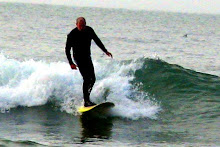
Thursday, July 23, 2009

July 23, 2009 Thursday


Bolinas

Groin

8:25 am to 10:40 am

1' to 2', sets to 3'

Low upcoming tide (-1.3 ft at 7:00 am)

North cross breeze

High fog - the June gloom continues

Fun session


I was starving for some good waves. Last week there was nothing. I came down Wednesday and didn’t bother going out. Monday I went out into one to two foot weak powerless waves. Stormsurf was predicting a big south swell would hit this afternoon late, peak tomorrow and continue through the weekend. Prediction was a four-foot swell at 18 seconds, that’s big. I got up early and out the door anticipating that the first of the swell would be appearing this morning.

The south swell was barely showing. The one surfer in the water at 7:50 when I arrived was Kathy the biology teacher who was out at the Patch, twenty yards past the outside rock. With camera in hand I watched her catch a couple of long slow rides, not my cup of tea. The Groin had some beautiful small fast peeling lefts, maybe too fast. The ebb flow was still coming out of the lagoon and was knocking down the waves at the Channel. Seadrift side had some good rights coming through. With the tide coming up, I figured the waves at the Groin would get better, thus I decided to try that first.

The tide was still low as I entered the water. I walked out on a finger of sand that went out twenty yards from the end of the Groin wall. The good left curls broke at the end of this sandbar, perfectly formed waves sucking out in six inches of water. I lined up with the lighthouse shape structure at the top of the cliff just north of the Groin wall where a slight edge had formed. At this point the waves paused an instant between the first section and the inside lineup. By getting into the waves early at this point, I just enough time to jump up and position in the wave to make the inside section. This strategy worked and I caught ten good fast knee-high curls in an hour. As the tide came up the waves got bigger and more makeable. The better waves were long, fast and ended in shallow water. I was sent flying on one when I drove the skeg into the sand causing the board to abruptly to stop. On the rest I had to fall spread-eagle to avoid slamming into the bottom.

After an hour Josh the fisherman came out. Just three of us were out there. Josh, who is my age, has a unique style; he rides a 9-foot longboard on his knees and is very good at it. He takes off late, paddles at an angle, jumps up to his knees slightly behind mid-point in the board, turns with his hands on the rails and shifting his weight and varies speed by leaning or backing-off on his arms to move his weight forward or back. After seeing him connect with a fast inside wave I commented that his knee style was perfect for these fast peeling-curls. He loses no time or momentum trying to stand up. He has been surfing for years but has never surfed standing up. I thought it was because he had injured knees or hips. No, he started out on a boogie board, graduated to a kneeboard using fins and just didn’t learn to stand up. He didn’t like the fins and the small board was difficult to paddle. Thus he moved up to a longboard, kept riding on his knees and perfected his technique. From inside I watched him take off late on a three-foot wall, he swung left, leaned forward to gain speed, the wave began to break, he stuck his head in the white water, hung on to fight his way back into the swell and then leaned into a fast inside curl. In the old days, we called that maneuver a ‘head-dip’.

During the long lulls between sets, we chatted about surfing, fishing and the filling up of the lagoon. He told me about his trip last March to the Witches Rock Surf Camp in Costa Rica. The surf was great: warm water and sand beaches. No worries about rocks, coral or sea urchins. He went to Boca Baranca, second longest left point break in the world with mile long rides. This year his fishing is doing great. He has never seen so much life in the water. Whether close to shore or twenty miles out, the sea is teeming with fish, sea lions, dolphins, whales and pelicans. He claimed that a few big corporations would soon have a monopoly on all commercial fishing. The Bush Administration had set up a cap and trade system for controlling the amount of fish extracted from the sea. The allocations are based on previous years’ catches, thus the big firms that were causing all the damage with their dragnets received the largest allocations. Fisherman may sell their allocations on the open market, and the big firms with plenty of money are buying up all the allocations. Despite this he is optimistic that he will be ok since he is such a small operation. He is the last commercial fisherman in Bodega Bay. I asked him about the filling up of the lagoon. He thinks that it is getting deeper. He should know since he drives a boat out to sea two to three times a week. His theory is due to climate change the sea is rising putting more water into the lagoon, and the hills around the lagoon are healing; meaning trees and grasses are returning and less silt is flowing into the lagoon.

The tide kept rising, the wind was picking up and the summer surf camp hordes had arrived. Josh and I decided to head in. We commented as surfers often do, “those were some good waves,” and were looking forward to the arrival of tomorrow’s south swell.

Thursday, July 9, 2009

July 9, 2009 Thursday


Bolinas

Channel

8:40 am to 10:20 am

2' to 3', sets to 4'

Low upcoming tide (-0.5 ft at 7:30 am)

North cross wind

Sunny, blue skies, fog on the horizon

Fun session


I almost didn’t go out this morning. Internet data was “iffy” at best: 2 ft north swell at nine seconds combined with a 1.5 ft south swell and a minus low tide. When I arrived at Bolinas no surf vehicles were parked on Brighton Ave. Where was everyone? I starting thinking that I have other things to do, I could go for a run on the beach, join Kate for lunch, etc. I didn’t even bother to take my camera to check out the waves. Three guys were out at the Channel, the wind was offshore, the sky was blue and the sun was warm. A set of good right peeling three-foot waves came through. Same great shape we had Tuesday, that did it I was going. I hustled back to the car, got my camera, returned to the overlook, took a couple of quick photos, went back to the car, suited up, waxed up my board and entered the water at the Groin. Like Tuesday, I paddled to the sand island on the other side of the current coming out of the lagoon and walked my board out to the break.

The waves were smaller but the good shape was still there. After two fair right waves it was clear that today’s strategy was to wait of the larger set waves. The small waves didn’t have any punch. I sat way outside and waited patiently through the long lulls until the three to four-footers would appear. Long lulls followed by a set of six to ten good waves. Be patient son. With only three of us out there, crowd was not a problem. After an hour, the tide came up and the lefts began to break. I got one good left, waited a couple of minutes and connected on another one. Thus I moved over to the left side of the peak to catch the next good one. A sizable set approached, I let the first one go (never take the first wave of a set), the second one looked good but I saw a larger wave behind it. I went for that one, a perfectly formed four-foot left. With two stokes I was into it, dropped to the bottom, leaned into the wave, climbed to mid-swell and saw a beautiful curl forming in front of me. I stepped to the middle of the board, locked the inside rail under the lip of the wave, stepped closer to the nose and stood there frozen for what seemed a long time and just cruised across the top of a fast breaking curl. I cut back, turned into another section and again just stood there. It was a great ride.

During one of those long lulls, sitting way outside, I met Dan. I remembered him from Tuesday. He was a big athletic guy, in his forties, rode a 10-foot Jeff Devine longboard and was a good surfer. Earlier when paddling out I got a good view of him coming down a beautiful blue-green four-foot wall of water. He was relaxed and confident as he maneuvered around the white water sliding down from the top of the wave, climbed back to mid-swell and cruised for fifty yards. Dan lives in Mill Valley but this week the family had rented a house at Seadrift. For fun he plays in a band, “The Close Enoughs”. For the last few Fourths his band has played at Stinson Beach. Dan’s vacation was performing on the Fourth and renting a house on the beach for the week. He was having a great time. His nine year old was loving jumping in the water with his boogie board. Dan learned to surf in North Carolina, surfed Cape Hatteras and several other beaches I never heard of.

“Dan, I know North Carolina,” I said. “My son graduated from Duke.”

“Oh no,” he replied. “I can’t talk to you. I’m a Tar Heel.”

Dan went to the University of North Carolina at Chapel Hill. He talked about surfing in Nantucket. When growing up his family would vacation on Nantucket Island, where due to how far the east the island was situated, nothing obstructed the south swells, resulting in some great waves. He also talked about surfing once a month in the winter in Massachusetts. They had to leave cars running, crunch across the snow to the water, catch a couple of waves and run back to their cars where the heaters were on high. Dan and I had a great time telling stories and sharing these fun waves at the Channel.

Tuesday, July 7, 2009

July 7, 2009 Tuesday


Bolinas

Channel

9:00 am to 10:30 am

3' to 4', occasional 5'

Mid incoming tide (minus tide at 6:30 am)

North cross breeze

High fog, overcast

Fun session


I didn’t have high expectations this morning but the Internet did report a three-foot fifteen-second south swell at 220 degrees, which comes right into Bolinas. Russ was suiting when I arrived. He was heading to the Patch to join Kathy the biology teacher and Hans who were already out there. I was thinking about the good rights I had on Monday June 29th.

An older surfer (about my age), who I had seen before here and who I knew was good, was suited up and waxing his board. He had a classic 9’ 6” longboard in perfect condition, clear-green color, doubled glassed on the rails and one macho-size curved skeg fiber-glassed into the bottom. Similar to the one I have on my 1967 10’ 6” Deese board that now decorates the front of my garage. I asked him about his board. He said it was a Dave Sweet board that Dave had made for him two years ago. I remembered the name but couldn’t place it. He claimed that Dave Sweet was the inventor of the foam board and was a big time shaper in the sixties. He also stated that he was on Dave Sweet’s surf team in 1965. I knew the guy was good, but that cemented it for me.

Later on I did look up Dave Sweet in the Encyclopedia of Surfing. There he was: owner and shaper of Dave Sweet Surfboards from 1956 until he closed his business in 1974. He was located in the Malibu area and built boards for several of the big time movie stars including Clark Gable, Cliff Robertson and Peter Lawford. From 1953 to ’56 he poured his heart, soul and all his money into perfecting polyurethane foam blanks. Sixty miles south Hobie Alter and Gordon Clark were going through a similar trial and error process, but Dave Sweet beat them to market by two years.

I walked down to the Groin wall with the camera in my hand. Three surfers were out there. The older one comfortably paddling on his knees was our Dave Sweet team member. I stood there with the camera on and focused and waited, and waited. Nothing came through. I turned the camera off and waited. Suddenly I had my doubts about going out; I do have a lot of things to do at home. After ten minutes a set came through: six four-footers that peeled off beautifully to the right. My Dave Sweet friend connected with one at the peak, cruised down a solid face, walked to the nose and hummed through a fast section. That did it; I was going to go for those good rights.

Entering the water I met Professor Steve who was just finishing his morning workout. He mentioned that he had connected on a couple of good rights. Low tide had turned at 6:30 am and the flood tide was just beginning to flow into the lagoon. I paddled across the current to the island of sand in front of the peak. The channel was fairly deep right up to the edge of the island. I walked across the coarse sand and shallow water to get out to the peak. My Dave Sweet friend asked me what took me so long. Photos and chatting with friends I replied. I mentioned that I thought a got a good shot of him (that’s him in the above photo). “Surf photos!” he exclaimed. He was impressed.

Between the long lulls a set of ground swells that stretched across the Channel would suddenly appear. The sandbar caused them to break at one consistent point and to peel down the mound of sand of the bar. I was prepared for the rights but here came a four-foot left swell. I went for it, quickly jumped up, cut left, looked down a steep wall of water, climbed high in the wave, locked my inside rail under the lip, trimmed down a fast paper-thin curl, stalled for an instant to let the wave build up again and cruised down another section. What a great ride. A few minutes later I did it again. I knew the rights were longer, but if the lefts were good why switch?

Another set came in, my Dave Sweet friend was in position for a five-footer and stroked into it as I paddled over it. I thought he would never make it. I was wrong. Looking back I saw him swing right, climb high in the wave, lean into it, crouch down and watched only his head accelerate just in front of the white water of the breaking wave, and on and on he went.

I was sitting way outside when the next set approached. Never take the first wave of a set I reminded myself. So I let the first one go by. The second wave was bigger, but I could see a bigger one behind it. I let the second wave pass. I paddled further out and a five-foot wall approached. It looked like it would close out but I decided to go for it. With two strokes I was into it. I looked down a head high line of water that was feathering at the top and it held up. I turned right, planted my rail mid-swell and gained speed. Two surfers were paddling out. One was directly in my path; I straightened out just enough to get by him. I missed his tail-block by six inches. I wanted to make this wave, but the slight turn caused me to drop to the bottom of the wave and lose momentum. I tried to cut right again to get back into the swell. The white water started peeling top to bottom and I could not get by it. I stood leaning on my inside rail trying to clear the white water. I didn’t make it. The wave collapsed, my board shot out from under me, my feet flew up and I landed tail-first into the white turbulence. It was a thrilling ride while it lasted.

For an hour and a half, I shared great waves my Dave Sweet friend and three others. We were a mellow crowd and had a great time.

Wednesday, July 1, 2009

July 1, 2009 Wednesday


Bolinas


Groin

8:30 am to 10:45 am

Consistent 3' to 4', sets head high

High outgoing tide

South onshore breeze

Overcast, high fog, June gloom

Fun session


At 8:00 am I was taking photos of the three to four-foot waves at the Groin when I spotted Yoshi coming down the beach suited up and board in hand.

“Yoshi, Kate and I had a great meal at your place the other night,” I said. Yoshi and his wife own Umi’s Sushi on Fourth Street in San Rafael. We ate there for the first time Monday night before seeing the movie Food, Inc at the Rafael. The movie was an expose of the industrialization of America’s food. Yoshi’s restaurant is the opposite: fresh ingredients, small quantities, expertly prepared. He commented that food production is changing in Japan and that he presents the traditional Japanese dishes prepared in the time-honored manner.

“How’s business?” I asked.

“Business is like the surf,” he replied. “Some days it’s up, others it’s down. Monday was busy and yesterday was quiet. You never know.” We shook hands and he entered the water for a short session before heading back to prepare the day’s specials. That’s Yoshi in the above photo.

Hank with his big yellow board showed up. Hank is the Western Regional Director of Reitz-Carleton Hotels. I hadn’t seen him in weeks.

“Hank has the hotel business improved?” I ask.

“No. It’s still the same. It sucks,” he replies. “Rates are really down.”

“What about the low-end?” I continue. “Motel 6 must be doing well.” In retail and restaurants the low-end establishments, Wal Mart, McDonald’s etc, are growing in sales.

“I don’t think they are doing any better,” he replied. “There just aren’t customers. So they are down also.” Reitz-Carleton manages the hotels, but the properties are privately owned. Hank stated that several owners are suffering and some are selling because the need the money. Now is not the time to sell a major property, so most are holding out. Despite the recession Hank did take his yearly vacation to the Reitz-Carlton on Maui and had a great time.

Four of us sat at the peak at the Groin: Hank, Claude, Rene and myself. We were on the left side of the sandbar. Monday the rights were firing. Today, the rights were gone and the lefts were pumping. The Internet had reported a four-foot ten-second north swell combined with a three-foot fourteen-second south swell. Sizable ground swells stretched across the Channel with the sandbar forcing them to break continuously to the left. They were fast, bumpy, tricky to catch, difficult to make, and often reformed on the inside into decent fast breaking curls. The ground swells pushed a smaller swell in front of them. One had to catch the top swell, gain some momentum and drop over the edge of the front swell. Once over the edge of the front swell, I would lean into the curl, trim under the white water sliding down from the top, watch the wave reform and step to the middle of the board when the good inside curls would jump up. They were long fun rides.

Claude mentioned that the “Malibu Rights” were breaking. Often at high tide a small Malibu like right curl forms near the Groin Pole. Claude is an excellent surfer, big guy, ten-foot board and powerful arms. He powered into flat swells, stood up, swung left before the waves jumped up. I caught a side view of him gliding into well-formed four-foot wall, driving left for a long ways before the wave broke in front of him. I paddled over the wave and looked back to see him continue on and on. He was working the wave while it reformed. Near the Groin wall he swung right. I could only see his back and head, but all of sudden he accelerated to the right as he worked his way into a Malibu right. He ended up way on the inside of the Groin wall in about one foot of water five feet from shore.

Russ came out and joined us. He worked his way further north and on the inside. While paddling out he mentioned that he had connected on some good inside ones, with smooth water that allow him to get into the shoulder of the swell. Russ has a hip that troubles him thus his technique is to jump to his knees, work to the shoulder of the wave and then stand up. With these fast breaking waves jumping to his knees was difficult to do. But the inside waves often provided the time to do it. I decided to join him and caught my best ride of the morning. A big set approached, I let the first two go by and continued paddling out because I saw a bigger one outside. I was in position to stroke into a five-footer. I heard of the roar of the wave as it broke down the line. I paddled into the shoulder, swung left, saw a huge green-grey wall of water before me, climbed high in wave, crouched down, slid under the white water breaking in front of me, climbed back into the swell, shot through a second section, eased up a bit to work into a third section, continued humming across a steep face right into the shore break where I dove into the wave to avoid being pounded into the sand. What a great wave.

After that Russ and I agreed one more and call it quits, but it never happened. The ebb tide flowing out of the lagoon was knocking down the waves, and the current swept us north. We had to paddle against the current to stay in the impact zone, and the sets never came. For half an hour, we tried for and missed several smaller ones. After missing one, I was ten yards from shore and decided to just paddle in.

Again, it was just another Marin morning: beautiful scenery, fun waves and good company.

Monday, June 29, 2009

June 29, 2009 Monday


Bolinas

Channel

8:00 am to 10:30 am

Consistent 3' to 4', sets head high

Mid outgoing tide

Slight onshore breeze

Sunny and warm, fog on the horizon

Fun session


What a difference the weather makes. Today was ideal: warm, sunny and great waves. Last Friday it was miserable. June gloom, overcast, misting, strong south wind, choppy surface, and white caps that obliterated the impact of a decent three-foot swell. As I turned the corner onto Brighton Ave in Bolinas I saw Cathy from the Russian River area drive by in her pick up truck, and then Mary drove by, shortly followed by Marty. It was 8:00 am and they were leaving. I didn’t bother going out. That afternoon a high-pressure heat wave moved in. Saturday and Sunday were hot and this morning the heat was subsiding but it was still warm with a lifting fog, sun breaking through high clouds and ten surfers out at the Channel.

Marty, Doug, Jim and Hans were out there. From the overlook I saw a decent peak mid-Channel with rights peeling continuously for a long ways towards Seadrift and the lefts were closing out due to shallow water. The path of the outflowing water had shifted. It now swung north just beyond the Groin Pole forming an island of sand straight out from the mouth of the lagoon. The peak was a hundred yards out from there. Lines of water that stretch across the Channel marched in. The sandbar shaped the good right waves, causing them to break consistently at one point and peel along the contour of the beach to Seadrift. The NOAA buoys reported 58-degree water, which is warm for Bolinas, an eight-foot north wind swell combined with a 2.4-foot south swell, remnants from a gale off the coast of Chile. Despite ten surfers already there, I decided join them.

On the beach I met Cathy from the Russian River area who introduced me to her husband. They were camping in Bodega Bay and decided to check out Bolinas this morning. Out in the water I asked Marty about his trip to Kauai where he connected with some great surf and then stepped on a bed of sea urchins whose spines kept him out of the water for a few days. I asked Jim about his gig last Friday. Jim is a jazz guitarist and lands jobs playing at hotels in the wine country. Due to the recession the hotels are down and so are the gigs, but this one went well, standing room only. I asked Professor Steve how his book project was coming. He is co-authoring a study on Hamlet. Steve said he was building the index, which means the initial draft is done.

After taking a couple of waves, one left and one right, I implored the same strategy I used three weeks ago here when the rights were firing. The approaching swells were flat and would jump up when the hit the shallow sandbar. I would sit way outside, position myself at the apex of the peak, wait for the bigger set waves, paddle hard, get into the waves early, set high in the wave and be in position to hum down the curls when the waves jumped up. The strategy worked and I connected with numerous long rides. I would jump up, swing right, glide through the initial section, cut back into the breaking part of the wave, swing right again as the wave jumped up into a steep curl and shoot through a second and sometimes a third section. The larger waves looked like they would close out as they approached. On one I took off late thinking I wouldn’t make it but I would give it a try. I cut right, looked down a beautiful head high blue-green wall that was feathering ten yards in front of me, trimmed through the first section, stepped to the middle of the board and sailed down a second section. It was a great ride. After an hour the tide dropped some causing the lefts to break in deeper water, and I applied the same tactics to a few lefts.

The others were getting good rides also. While paddling out, I got a good side view of Professor Steve locked in a four-foot curl, crouching down mid-curl with white water of the fast breaking wave pounding right behind his head. I paddled over the wave while he shot by and watched him travel on for another fifty yards. I caught another good side view of Marty connecting on a long well formed left. Jim, who was also sitting outside with me, caught a few good long ones.

I met David a longboarder in his 50s, on a Stewart black and white board, on the right side of the peak. He got some good rides. After observing one of his long rides I complimented him as he paddled back out. He gushed with excitement about how good it was, how much fun he was having and how today was the best of the last three days. He lives in San Rafael but this week he and his family were renting a house at Seadrift.

“Stacation,” I said to him. “That’s what the locals call what you are doing. Vacationing close to home. The local businesses are doing well here in Bolinas and Stinson because people are taking local vacations.”

“Wish I could say the same,” he replied. “My business is tanking.”

“What do you do?”

“I own four radio stations in the Midwest and like newspapers, revenues are down.” Meanwhile he has moved his family back here and commutes to Chicago. The good waves were definitely getting his mind off his economic woes.

I also met Jeff a young shortboarder from Sebastopol. He was an expert surfer connecting on both lefts and rights. His local break is Salmon Creek and sometimes Dillon Beach. He was here due to the strong winds up north.

“The water must be five degrees warmer here,” he said.

“That’s because of the lagoon,” I said. “It’s shallow, the sun heats up the water and the low tide then pours the warm water out here.”

“Marty, this is like surfing at the Seal Beach Power Plant,” I reminded Marty. “Do you remember that?” Marty learned to surf in his high school years at Seal Beach and the south end of Long Beach. The Power Plant used seawater to cool the stream boilers, and they pumped heated water back out into the break. The water was 85 to 90 degrees, bath water that would melt the wax right off of your board.

“Today the stingrays have returned,” Marty replied. “They love the warm water and have taken over. You can’t surf there anymore.”

Bright sunshine, warm water, mellow crowd and good waves made for a great session. In an exchange of emails later on both Professor Steve and I agreed that today was special.

Friday, June 19, 2009

June 19, 2009 Friday


The Big Drop, edited by John Long

John Long’s The Big Drop (copyright 1999) a collection of 32 classic stories about big wave riding is a fantastic read and highly recommended for surfers of all ages. The book has been around for ten years yet I never heard of it. In the middle of the shelf of Border’s good inventory of books on surfing sat one copy. It had six stories by Bruce Jenkins, yes, the noted sports columnist of the 3 Dot Lounge for the San Francisco Chronicle. Jenkins is a surfer, lives in Montara, is a contributing editor to Surfer magazine and has written numerous articles and books on surfing. A few years ago I purchased and read his excellent book, North Shore Chronicles. Other renown contributors are surf journalists Ben Marcus (former editor of Surfer), Matt Warshaw (another former editor of Surfer and author of the Encyclopedia of Surfing), and Phil Jarrett (author of Mr. Sunset, the Jeff Hakman Story) and famous surfers, Gerry Lopez, Greg Noll, Mark Foo, Brock Little, Fred Van Dyke, Ken “Skindog” Collins, Buzzy Kerbox and Peter Cole. With all these big surfing names assembled in one book, how could I go wrong? Despite being a tight SOB, I splurged and bought it.

Who is John Long? I never heard of him before. Long is an extreme rock climber and author on the sport. His instructional Advanced Rock Climbing has sold over a million copies, and his award winning short stories are known for taut action and psychological intensity. He grew up in Southern California and loved the surf culture, often paying his buck to watch the surf films shown at local high schools. On a movie assignment on Oahu, a massive swell hit Waimea. He witnessed the giant waves and heard the exploring carpet-bombing sound of the enormous breakers. He watched four guys trying to paddle out, three made it out and one didn’t. The one went over the falls and his board explored into three pieces. Thinking the day was over for this young warrior, Long was amazed that this determined surfer grabbed another board, paddled out and caught several huge waves. That did it for him; big wave riders are a breed apart. He began a quest to assemble the ultimate stories on big wave surfing, a true adventure sport. Small wave riding doesn’t count. Adventure sports have one overriding constant: a break in form or an error in judgment can kill you. He apologizes for omissions but feels these stories are the ones that had to be told.

“Big Wave Surfing Timeline,” by Ben Marcus, the last article in the book, lists the famous milestones and events in big wave surfing. This collection covers several of them.

“Death of Dickie Cross,” as told by Woody Brown to Bruce Jenkins, December 22, 1943 gives an eyewitness account of the first surfing death at Waimea Bay. Woody Brown and Dickie Cross got caught outside on a monstrous day at Sunset Beach. Brown was a pioneer of Hawaiian surfing, inventor of the catamaran, a well-known fixture at Waikiki and was featured in the movie Surf for Life. A clean-up wave appeared on the horizon, they barely scratched over it and decided to get out of there. They paddled several miles to Waimea thinking the deeper bay would present a better opportunity to paddle in. A huge set came through the Bay and Dickie lost his board. Brown was paddling in to get him and Dickie was swimming out when another huge set arrived. Woody turned and paddled out trying to save their only board. He wasn’t going to make it, he let the board go, dove for the bottom and when he surfaced he never saw Dickie again. Dickie’s death cast Waimea as unsurfable for 15 years to until 1957 when Greg Noll and crew successfully challenged the Bay.

“Outside Pipeline 1964,” by Greg Noll and Andrea Gabbard, November 1964, describes the epic day depicted in the above photo. As Greg puts it, “What many people don’t realize is that the wave in the picture is just the shorebreak. Horrendous as that shorebreak looked, it was small change compared to the monsters breaking nearly a mile beyond.” Greg and friend Mike Stang went out and it took them one hour to get beyond the shorebreak. Greg spent seven hours in the water and caught one wave, a 25-foot bomber that grew in size as he sailed down it. He rode it all the way to the inside break and charged on instead of pulling out. The speed was so great he was skipping down the face in 15-foot jumps until the speed and wind blew him off the board, ending in a horrible wipeout near the shore.

“The Last Wave,” by Greg Noll and Andrea Gabbard, December 4, 1969, describes the once in a century 1969 swell and Greg Noll’s riding the largest wave ever paddled into. The epic swell closed out all the breaks on the north shore, so Greg drove around Kaena Point to Makaha on the west side of Oahu where the waves are smaller. He paddled into a monster wave, dropped down a face that could have held two eighteen wheelers stacked on top of each other, then into a cavernous green room where there was no escape. Tons of white water collapsed on him, pushed him under and trashed him around, but soon released him. Now he had the difficult task of swimming in. As he was swimming parallel to the beach to avoid the rocks he could see his good friend Buffalo Keaulana sitting on shore in his lifeguard truck. Greg finally flopped on the beach. Buffalo shoved a beer into his face and said, “Good thing you make ‘em Brudda. Cause no way I was commin’ in after you. I was jus goin’ wave goodbye and say Aloooha.”

“Man Imitates Abalone,” by Jeff Clark as told to Lawrence Beck, winter 1992 describes Jeff’s ordeal of being stranded on top of Maverick’s Ship Rock. On the inside of Mavericks lies an outcropping of three huge rocks, the biggest one known as Ship Rock. Normal rides move the surfer down the line away from these rocks. But in this case, the wave doubled up early in the drop and dumped Jeff in front of them. The strong current and huge waves pushed Jeff onto Ship Rock. He scrambled to the far side, made like an abalone and clung onto the crevices of the rock while ten waves pounded over the top of him. Friends came to his rescue but they could not get to him. Another friend stood at the base of the cliff and shouted to Jeff when the waves were coming. Finally the friend yelled to Jeff to swim for it, which he did and made it to safe water. Jeff refers to this ordeal as “just another day at the office.”

“The Apprenticeship of Jay Moriarty,” by Jason Smith, December 21, 1994 begins with 16-year-old Jay Moriarty describing his famous wipeout that put him on the cover of Surfer and into national notoriety. Jay did an ass first free-fall down the face of a 25-foot wave that drove him to the bottom and bounced him off the reef. He wasn’t just some inexperience kid paddling out there for the first time. Under the tutorage of Rick “Frosty” Hesson, Jay had prepared for Mavericks for three years. At age thirteen Jay knew he wanted to ride big waves so he began hanging around Frosty and the older Santa Cruz big wave riders. After some reluctance 45-year-old Frosty agreed to teach Jay how to ride the big ones. Frosty’s approach with Jay was a comprehensive study of surfing. With Jay feeling like the Karate Kid, Mr. Miyagi (Frosty) assigned him an essay to get his thinking processes down. During his tutorage, Jay wrote over 55 essays while excelling in the physical exercises of distance paddling, surfing, swimming and biking. During extreme low tides, they would study the rock reef at Mavericks and draw diagrams of it. Jay’s graduation came in April 1994 on a late-in-season Mavericks 15 to 18-foot day. Jay left Frosty in his wake in the paddle out, went straight to the peak and connected on a clean long wall. He was ready.

“Death of a Legend,” by Matt Warshaw, December 23, 1994 gives an in-depth account of the drowning of big waver rider Mark Foo at Mavericks. It was Mark’s first time out at the northern California break, he took off on a medium size wave, half way down the face pitched forward and splashed into the water. There was nothing special about this wave. Everyone’s attention immediately turned to the next wave, a bigger one where Block Little and Mike Parsons were taking off and both were buried in white water and were soon being swept into Sail Rock. No one noticed that Foo didn’t surface. Ken Bradshaw and Mark Foo had flown all night from Hawaii, landed in San Francisco at 5:30 am, connected with friend Doc Renneker at Ocean Beach and arrived at Mavericks at 9:30 am. Cold water, warm day, slight offshore breeze and all the Mavericks regulars, boats and photographers were there. The waves were average thus a mystery revolves around how Mark actually died. Warshaw sums it up this way: Foo drowned, Parson nearly died and Little had what he called a “heavy experience” all from a single set of waves. Along with Pipeline Mavericks is one of the most deadly big wave spots in the world.

“Laird Hamilton,” by Bruce Jenkins fills in the growing up years of this surfing legend from the incredible story of two-year-old Laird choosing big time North Shore surfer Billy Hamilton as his father, to his hanging around with big wave riders Jose Angel and Butch Van Artsdalen to his pioneering of tow-in surfing at Jaws off Maui. Laird was an energetic holy terror of a little kid. When surfers lost their boards at Pipeline, Laird would grab them and bury them in the sand for a joke. He lit off firecrackers under the decks of parties and threw cans filled with sand at passing surfers. In school Laird was the only hoale (white kid) and had to fight his way to respect. On his first day of school in the 11th grade, Laird got into a fight and decided then that school was not for him. He dropped out, learned the trades becoming an expert craftsman and surfed. Laird has overcome his raging side and has become a perfect gentleman. On a tour of Laird’s old haunts on Kauai, Billy Hamilton showed Jenkins the hills, forests, moss covered rocks, cliffs and trails of Laird’s playground where he ran around full tilt barefooted for hours everyday. They encountered Bobo Ham Young, long time friend of Billy and Laird’s. Per Bobo, his grandfather practically raised Laird. He was always with them at their family gatherings. Laird may be white but inside he is Hawaiian, pure Aloha spirit. He always stops the car to come over and greet the old ones of the family.

Laird’s story reads like an ancient Greek myth. Laird’s mother commented that her brief encounter with Laird’s father was just to have Laird, and she married Billy because Laird had chosen him. Hercules, Achilles, Jason and Laird Hamilton could all be part of the same legend.

The Big Drop, edited by John Long, gets the Lorenzo Five Star rating, so check it out.

Monday, June 8, 2009

June 8, 2009 Monday


Bolinas

Channel

7:50 am to 10:30 am

2' to 3', sets to 4'

Low upcoming tide

Offshore (N), to cross-wind (NW)

Overcast, high fog

Fun session


The rights were firing today. At 7:00 am nobody was out as I stood south of the Groin wall to take some photos. The minus 1 foot low tide had just turned, ebb tide was still flowing out of the lagoon but was slowing. At mid-Channel, two to three-foot walls were peeling left and right. The south swell was still with us. The rights looked good with long continuously breaking fast curls shooting into the bay towards Seadrift. The lefts were sucking out in six inches of water, impossible to ride. The rights could be breaking too fast to make, but with the tide coming in conditions should improve.

Back at the cars, the crowd began to arrive. Kathy the biology teacher with board in hand headed for the Channel. Hans was suiting up. I told him the Channel looked better than the Patch. Doug and Jim pulled up and were glad that the call was the fast breaking Channel instead of the slower breaking Patch. Marty arrived and was ready to go. A couple other surfers showed up and by the time I entered the water we had a small crowd of eight at the mid-Channel peak.

The waves were tricky to catch. The swells were true ground swells, not wind waves. They stretched across the impact zone, approached flat and would jump up when they hit the sandbar and would break quickly to the right. On my first wave, I took off late on a two-foot wall, jumped up and was quickly dumped as the wall collapsed all around me and sent me flying. Then I knew I can’t take off late; I’ll have to get into the waves early, stay high in the curl to make the first section. This meant going for them when the swell was flat before they hit the sandbar and paddling hard to gain board speed to get into them as they jumped up. The sandbar forced all the waves to break to the right. Don’t even think of going left (my favorite direction) because they all are going to start breaking at the apex of the sandbar and quickly peel to the right. Each wave I caught proved I was right. I kept positioning myself closer to the apex instead of sitting on the shoulder. With board speed I could get into the wave early, turn sharply to the right, hang at the top of the curl and shoot through the first section. Having locked in my strategy, I had one of the best sessions that I have had in weeks.

The others got good rides also. Marty and Kathy caught several good ones. Doug took the strategy of sitting on the right-hand edge of the peak, waited for the sets, connected with the four-footers and cruised on several long, long, rights until then died out on the Seadrift side of the Channel. Jim was having a difficult time with the fast peeling rights. Many a time I saw him bear hugging his board as the nose pearled coming down three-foot peaks. But he also connected with a couple of set waves, got up cleanly and shot down long clean right walls.

After two hours, I worked my way in. The tide had come up and the lefts were now rideable. Joe the unfriendly local surfer was at the north end of the peak straight out from the Groin Pole. From a distance I saw him connect on two fast left breaking curlers. I’ll go for a couple of those to end my session. I caught two of them. First one was slow and the second was a sucking out two-foot curl that I made. I rode that wave for all it was worth, driving through the small curl, straightened out, dug my skeg into the sand and stepped off in a few inches of water. It was a great session.