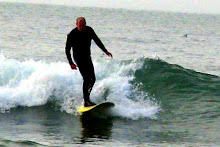
Wednesday, November 11, 2009

November 11, 2009 Wednesday


Bolinas

Groin

8:50 am to 10:30 am

2' to 3', sets to 4'

Mid outgoing tide

Offshore breeze to NW cross breeze

High overcast with patchy sunshine

Fun session


“Why are there fourteen people at the Groin at 8:00 am on a Wednesday?” I asked a young surfer standing next to me on the seawall checking out the waves. “Don’t these people have to work?”

“It’s Veterans Day,” he calmly replied. “The schools are out, the banks are closed and there’s no mail service today.” Well that explained it. We watched these surfers paddle for and miss weak two-foot waves at the Groin. The tide was too high. The swells wouldn’t break until they were within a few feet of the Groin pole.

“It looks like a paddle session to me,” Martha said as she was heading down the ramp to enter the water. I asked her if she was out this weekend for the big waves. “I came out Sunday,” she replied. “The waves were big and bumpy. I didn’t have a good time.” I had heard others talk about how frustrating this past weekend was, big crowds and big waves without much shape. “I think this place is better on a three-foot south swell than on a twenty-foot north swell,” Martha added and I agreed.

“Maybe I should have gone to Stinson,” I said to myself after a half hour paddling for and missing small waves at the Groin. Expectations for fun waves looked good this morning: 8 ft north swell at 11 seconds and a 5-knot NW wind. I had joined Martha and David who rides the Becker board at the peak north of the Groin wall. I paddled for a wave that I was sure I was going to catch but just missed it and some guy who had caught it at the furthest peak came cruising by me. “That does it, I’m going out there.” By now the outgoing current from the lagoon was rippling through the outside peak putting a texture on the surface. I paddled over there and still I couldn’t catch a wave. Within a few minutes the current had moved me outside beyond the impact zone. A big set approach, I paddled for the first wave and missed it, I paddled for the second it and missed it also. Now I was several yards closer to shore. The third and biggest wave of the set approached, foam was forming at the top, I went for it, dropped down a head-high face, plowed under white water from the wave breaking in front of me, climbed back into the swell and cruised through a good section. Finally I had caught a wave.

From outside I watched someone trim on a right wave in front of the Groin pole with great speed. It was Martha. I saw David connect on a good left curl close to shore. “That does it, I’m moving inside with them.” Good move. I caught several fast curls right up to the shore. The tide had dropped causing the waves to become steeper. Here we were inside of the outgoing current from the lagoon so the surface was smooth. On one I took off late, turned quickly to the left, got high in the curl and stood there just under the lip of the wave. My legs felt like shock absorbers as I bumped over a series on one-foot backwash swells bouncing off the seawall.

“Party wave,” yelled Dan to Professor Steve and I as we were stroking for a well-formed three-foot peak. I pulled back to let them have it. Dan took off, dropped into a crouch with his back to the wave. I turned to watch. Dan had disappeared. I thought he had wiped out, but then I noticed the wake of his board tracking ahead of the breaking part of the wave. After a long ways, he popped up still in the critical part of the wave as it broke onto the shore. What a great ride. I saw David on a good one. He took off with his back to the wave, cut left, trimmed through a fast section, cut back, turned left again and cruised through a fast inside section. For a guy who had just started surfing he is picking this up in a hurry.

After connecting on all those inside curls, it turned out to be another fun session for the old kid here.

Saturday, November 7, 2009

November 7, 2009 Saturday


San Francisco

Fort Point

5:00 pm to 6:00 pm

8' to 10', sets to 12'

Mid outgoing tide (4.0 ft)

West cross wind

High overcast

Just taking pictures


Stormsurf’s Storm #2 arrived this morning early: 11 to 12 ft swells at 17 to 18 seconds. When Stormsurf numbers a swell, Maverick size waves are coming. They tracked this swell all week. Tuesday, confirmed 40 to 50 knot sustained winds in the Gulf of Alaska. Wednesday, sustained winds continued, seas built to 32 ft on the great circle to Northern California. Thursday, 40 to 45 knot winds continued, seas grew to 40 ft and still on the path to Northern California. Friday, the storm began to fade but 37 ft seas continued moving towards California. The main focus of the storm would be from Point Reyes northward, with most energy going to Oregon and Washington. It was positioned close to San Francisco, 1000 to 1600 nautical miles, resulting in a raw and unruly swell that would last through Sunday and fading on Monday.

Son Kevin and I were doing things in the city and late afternoon on our way back to Marin we swung by Fort Point to check the waves. The waves were huge, smashing against the rocks and sending plumes of spray up onto the road leading out to the fort. Six surfers were in the water. The waves were rough, bumpy, not well formed and coming in different directions. The big set waves broke under the bridge, pushed into the Bay and then turned 90 degrees to wrap around the point. Most waves came more from the middle of the bay, would peak and break near the rocks of the parking lot. Some peaked right at the point and broke over the big fill rocks that form the foundation of the road and parking lot. Others peaked further away from the point, some twenty yards east. These waves were bigger and barely broke due to the deep water. The water is deep at Fort Point, thus the waves only break during low tide and near the shore. The depth increases as one moves away from the fort and further into the bay.

The surfers were having a difficult time catching waves due to the strong currents and the shifting direction of the peaks. Nonetheless the rides were spectacular, every one was two to three feet overhead and fast. They would sail down a steep overhead face and plow into a flat shoulder. To stay in the swell, one has to cut back towards the rocks and work back into a reforming wave. The white water pushes towards the fort and the parking lot. The danger here is getting too close to the rocks. I watched one your short boarder pull out on the inside and immediately started scratching east away from the rocks as the next and bigger wave of the set broke in front of him. Being skilled at ducking diving, he calmly went under the wave and continued paddling east out of the impact zone.

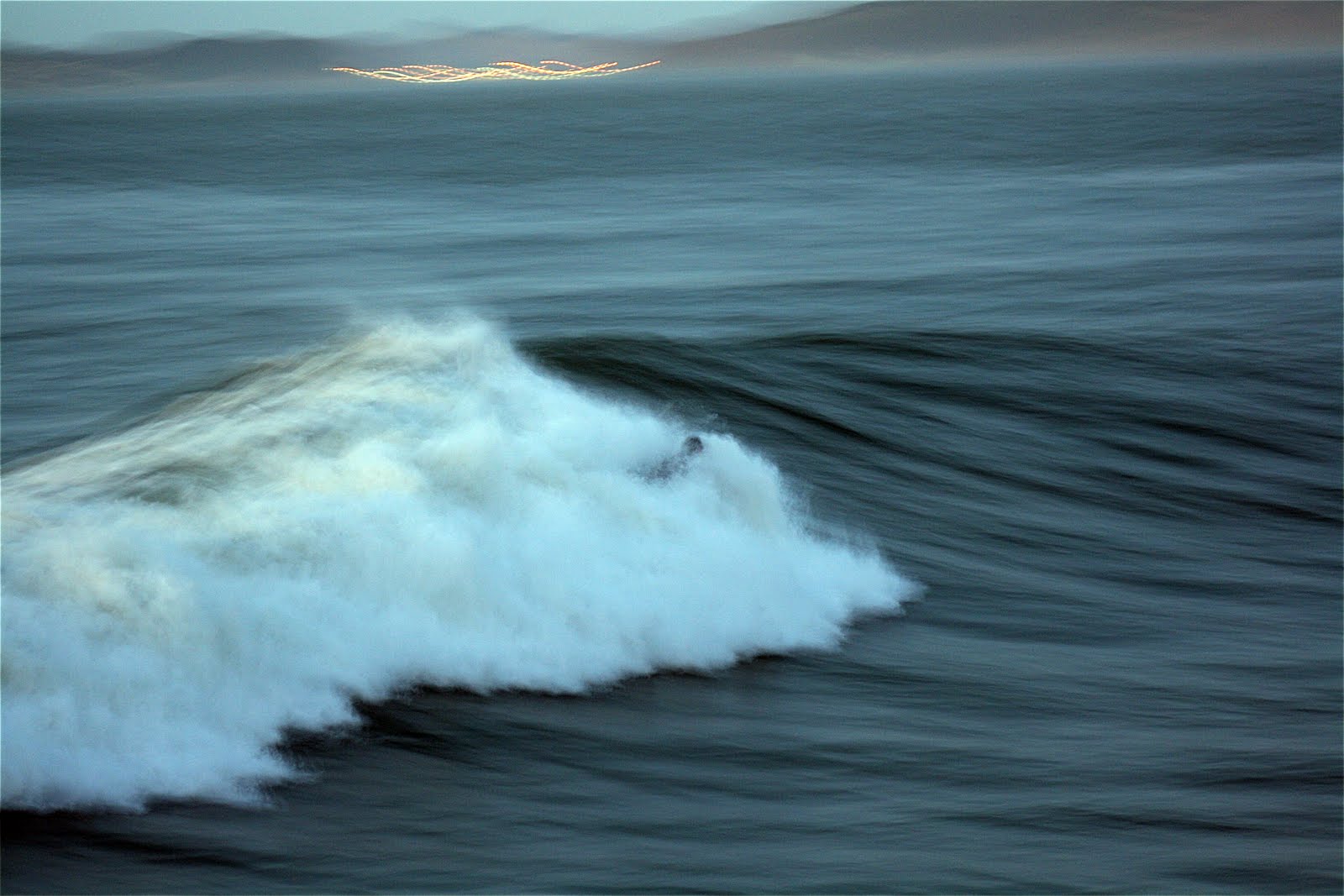
What a tremendous place to watch waves. There we were, along with another 100 observers, standing at the point, on top of the rocks, within 50 feet of these beautiful and powerful twelve-foot waves that roared in from the sea and smashed against the rocks. I took several photos but due to the fading light the program of my digital camera held the shutter open to obtain light, thus all I captured were blurry images of the surfers. The above photo was my best and that was after all the magic Photoshop could deliver. This rider was on a boogie board. He caught the wave under the bridge and here he was near the end of his ride after the wave made its 90-degree turn around the point.

I have surfed Fort Point a few times. It is an eerie place to surf due to the rocks, strong currents, big waves and an aggressive crowd. But it’s a great place to watch big waves and skilled riders up close.

Monday, November 2, 2009

November 2, 2009 Monday


Bolinas

Groin

9:15 am to 11:15 am

4' to 5', sets 6' to overhead

High tide (6.2 ft at 9:45 am)

Slight onshore breeze to no wind

Bright sunny day

Good session


Last night the NOAA weather radio reported 9 ft at 20 second swells and this morning it was 8 ft and 17 seconds. A big swell had moved in yesterday afternoon. Stormsurf stated the swell was remnants from Typhoon Lupit:

"On Monday evening (10/26) the extra tropical remnants of Typhoon Lupit were tracking north-northeast off Japan with a tiny fetch of confirmed 60 kts west winds building in the storms aimed west. It was a fairly intense system, with confirmed winds of 60 kts for nearly 48 hours and a few barbs to 70 kts. That is impressive. Well rideable surf is possible for the Hawaiian Islands for the weekend with decent but inconsistent size for the US West Coast late in the weekend into the week beyond."

From the overlook I saw consistent four to five foot waves at the Channel and Groin, big powerful, rideable lefts with sets over six feet. Warm weather and a well publicized swell on the Internet drew all the Bolinas regulars: Marty, Mary, Doug, Matt, Dan, Russ, Claude, Professor Steve, David who rides a Becker board, Barry the motivational trainer and Yoshi.

I pulled into the parking area at 8:30 am. Mary, Doug, Marty, Dan and Russ had finished their sessions and were at their cars getting out of their wetsuits. Why were they getting out so early? Was the surf lousy? No way, each one of them claimed they caught several great waves and ordered me to get out into the water. So why are they leaving? It was the time change. These dedicated surfers schedule their days by the sun. They entered the water at sunrise, 6:38 am which was 7:30 am on Saturday, and surfed for two hours. I was on clock time arriving at my usual 8:30 am, which was 9:30 am two days ago.

A strong surge from the powerful swell, sand gone from in front of the ramp and the seawalls and a 6 ft high tide had the waves shooting white water up to the top of the ramp. Every wave crashed over the top of the north seawall. The only way to enter the water was to launch oneself between waves at the base of the ramp. I waited for a lull, jumped in and paddled like mad. My timing was good and I didn’t have any problems getting beyond the shore break. Two-foot waves were bouncing off the south seawall send a foot of white water out into the surf.

Even though the peak was a good five hundred yards offshore, the waves were bumpy due to the cross-swell backwash coming from the south seawall. They were also a combination of wind and ground swells. The best waves occurred when the two swells came together. I would catch the wind swell at the top and glide into the larger and more powerful ground swell. My second wave was a good one. The swells had combined, I stroked into the wave, swung left, look down a head high line up, climbed to mid-swell, stepped to the middle of the board and cruised through the first section. The wave was growing in size in front of me. A cross-bump from the backwash caused the wave to leap up into a sharp point and curl over. I had plenty of speed to drive under the white water and to climb back into the swell. On and on I went until I pulled out in the shore break.

Claude was out there having his best session ever at the Channel. He sat way outside waiting for “the big one.” He endured several long waits but he always connected. I sat further north and more inside waiting for the walls that peeled across the inside of the Groin. I got a great view of Claude on a good one. He stroked into a sizeable wave right at the apex of the peak. He dropped down an overhead face, disappeared behind the wall of water for a few seconds and then popped out on the shoulder. He stalled for an instant to let the wave build up and then turned sharply left again into a fast section. All I saw was his back as he sailed along a feathering curl. It was a great ride.

After a while, Barry the motivational trainer paddled out to join Claude at the outside peak. A big set approached. I contemplated taking the first one, but I saw Barry was paddling for it. Even though he was a good twenty yards away from me, I backed off. With waves this powerful one could easily travel twenty yards in an instant. I turned to paddle over the wave. Just before I pushed the nose of my board through the wave, I caught a glimpse of Barry at the base of the wave, standing straight up as a green wall feathered two feet over his head. Barry straightened out and rode out the white water of one of the largest waves of the morning.

As I wrote this I was sitting on a sand dune at Stinson Beach watching a couple of short boarders challenging this big swell. They would scream down these overhead glassy green walls and dive into the waves as curtains of white water would cover them up. It was just another incredible, sunny, warm, beautiful Marin fall day.

Monday, October 26, 2009

October 26, 2009 Monday


Bolinas

Groin

9:15 am to 11:00 am

2' sets to 3'

High outgoing tide (4.3 ft)

Slight NW cross breeze to no wind

Sunny, high clouds and fog on the horizon

Fun session


The last remnants of Storm #1 were still running today: 5 ft at 11 seconds. The weather was about to change, low pressure was moving in, pushing out the high pressure and the transition would produce two days of high NW winds, which means rough seas, chop and white caps. So today was the day to go out this week.

Eight surfers were out at the Groin at 8:30 am: Marty, Hans, Matt, Doug, Russ and three others. They were catching small, weak lefts at the only peak that was breaking. That’s Marty in the above photo on a good one. The Patch was flat this morning. Hans exited the water as I was suiting up. The crowd discouraged him. He went out early with Doug and Marty but within 30 minutes a dozen more people arrived and they all crammed together at the one and only peak.

The high tide was still pushing up the ramp this morning. I entered the water there and paddled out to the peak at the Groin. The waves were small but had decent shape. After my first wave I realized they lacked punch so I moved to the apex of the peak, which was half way between the Channel and the Groin, and waited for the set waves. Now I was in my element: sunshine, warm water, no wind, smooth surface and a peak of consistent well-shaped knee-high curls. On my second wave I turned into the peak, the wave broke in front of me; I coasted under the white water, climbed back into the swell and worked the wave for several yards. I did the same thing on several waves. The feel and glide of these nice peaks reminded me of small days at the reef at Cardiff by the Sea, where one glides down gentle swells for a long, long ways.

After an hour only four beginners and myself were out there. One of them was David who is about my age and rides a Becker longboard. I have seen him in the water a lot lately. Last week I asked him how he liked his Becker board. Phil Becker is the top board builder in the South Bay of Los Angeles. His home base is Hermosa Beach. David mentioned that he was just beginning and that he knew he knew nothing about boards. Friends in Hermosa Beach directed to this board and he bought it. I have owned two Becker boards, and my son Kevin has a beautiful eight-foot Mike Gee model Becker board. I didn’t tell David that I am a walking billboard for Becker Surfboards with my Becker baseball cap and three Becker tee shirts. I reassured him that he had an excellent board. While paddling out I saw David crouched down in the middle of his Becker board perfectly locked into a left three-foot curl. He cruised all the way to the shore. Yes, he was getting the hang of it.

I met Doug out there this morning. He is about my age, is just taking up surfing, lives in Berkeley, and is a psychologist with an office in Sausalito. He is in control of his time, has decided to only work four days a week and takes Mondays off to go surfing. He was having a great time on this beautiful morning.

As I was exiting the water I saw the back of some guy’s head as he crouched down and hummed across a six-inch shore break. It was Yoshi. Only Yoshi can ride the smallest waves in the world. Back at the cars he introduced me to his friend from Japan who was just ending a week’s stay in San Francisco. He was flying home tomorrow. I brought up the topic of baseball, knowing that it is a popular sport in Japan. They were Yankees fans because of Hideki Matsui, the Yankees’ designated hitter. They also root for the Seattle Mariners and their star hitter, Ichiro Suzuki. These two have become all-stars in the major leagues. Ichiro led the American League in batting average (.352) and number of hits (255). Hideki Matsui was named Most Valuable Player of this year’s World Series. In the six World Series games he batted .615 (8 hits for 13 at bats), had three home runs and 8 RBIs.

Again it was another eventful and beautiful fall morning in Marin.

Saturday, October 24, 2009

October 23, 2009 Friday - Part 2


Bolinas

Groin

9:00 am to 11:00 am

3' to 5', sets overhead

Low tide (3.4 ft at 9:00 am)

Slight offshore breeze

Sunny, warm and hazy

Good session


Today the waves were not huge but they were powerful with lots of push in each one of them. This swell was part of the Stormsurf’s Winter Storm #1, meaning a big north swell from the Gulf of Alaska. Mark Sponsler, the guy who runs Stormsurf.com, is the weatherman for the Maverick’s big wave contest. So when he gives a Gulf swell a “storm number” that means Maverick’s size waves are coming. Storm #1 arrived late Wednesday, peaked on Thursday and was still running today: 10 ft NW swells at 15 seconds. At Bolinas this translated to 4’ to 5’ waves with sets overhead.

Sizeable crowds were at both the Patch and the Groin. Mary, Russ, Hans, Hank and Robert the Oakland fireman were at the Patch. The Patch was smaller than last Wednesday because the three-foot south swell was gone. From the overlook I watched head high waves come through the Groin that nobody could make. Guys would drop down the face and plow into white water as the waves broke in front of them. Only at the very north edge of the peak and on the inside was there a nice rideable shoulder. I decided to go for that.

I paddled from the ramp to the inside peak at the Groin. Martha and Claude were there. So was the mid-fifties guy I surfed with last Wednesday at the Patch. He was the skilled longboarder with no booties, gloves, hood or leash, and yes he was the one who emphatically told the stand-up surfer where he could stick that paddle of his. Later on Professor Steve and David the Bolinas local joined us.

My first wave was a good one. As the wave approached I could see that it had some force. I stroked into it, turned left and looked down a beautiful wall that was feathering at the top of the wave for several feet ahead of me. I dropped down the face, slid under some white water, climbed back to mid-swell and cruised for a long ways. Paddling out I watch Martha drop down a head high wall that collapsed in front of her.

An outside set approached, the mid-fifties guy and I paddled out to meet it. The first wave of the set was beginning to break and I dug hard to get over it. My companion turned and went for it. In the instant before I pushed my head and board through the top of the wave I caught a glimpse of him taking off on this five-foot wall. As he dropped down the face, he was in a deep crouch on the inside rail of the tail-block with one hand stretched out gripping the outside rail. Once through the wave I looked back to see him crouched down in the middle of his board with just his head above the breaking part of a fast peeling wave. Later I complimented him on his ride. He told me that he got barreled on that one. Knowing how good he was, I believed him.

Twenty surfers were out at the Groin and the quality of the riders was good forcing me to be selective. The waves often sectioned in front of us and as the morning progressed they became steeper. A few of them crashed top to bottom. I dropped into a head high wall, stepped to the middle of the board, positioned myself mid-swell, crouched down and hung on. For a brief two seconds I screamed down a steep perfect curl until it buried me in a sheet of white water.

To beat the crowd I kept moving north and inside thinking about connecting with the steeper and faster inside curls. David was doing the same thing. But the crowd drifted along with us. About 10:15 am I hit a lull, fewer waves and more people. I finally connected on a good three-footer that I worked into the shore break. As I turned around to paddle back out I saw a three-foot shore break wave peel left along the contour of the shore. I decided to end my session in the shore break. I paddle out a short distance, turned and caught one that was reforming. I turned left, locked the rail under the lip of the wave, shot across a fast section and dove into the wave as it broke on the sand. I repeated this two more times and decided to call it quits.

When I first got up on the seawall this morning to take some pictures, I ran into Robert the Oakland fireman as he was coming back from his session at the Patch. I hadn’t seen him for months. Just last week Doug asked about him and none of us had seen him. He said hello, mumbled something about a good session and then proudly announced that he just had a baby. Well that helped explain his absence. This past year he fell in love, got married and they had a baby girl. He introduced me to his wife and four month old daughter, who is a big girl for just four months. Robert is still a fireman, he wasn’t called to fight the big fire in Los Angeles, but others in his company did go and Robert had to cover for them. They now live in Vacaville, which is 90 minutes from Bolinas and another reason why we don’t see him any more. He and his wife were having a fun time introducing their daughter to the beach.

Sunny and warm heat-wave day, with no wind, glassy conditions and a Gulf storm swell hitting Bolinas made for a perfect Marin fall day.

Friday, October 23, 2009

October 23, 2009 Friday - Part 1


Bolinas

Groin

9:00 am to 11:00 am

3' to 5', sets overhead

Low tide (3.4 ft at 9:00 am)

Slight offshore breeze

Sunny, warm and hazy

Good session


“Look at the red tide!” Professor Steve commented between sets out at the Groin peak. “Yesterday it was clear.”

I noticed a slight brownish-red tint to the water when I launched myself off the ramp into a three-foot approaching wave at 9:00 am. The color became more pronounced the longer we were out there. By 10:30 am, near the end of my session, the water was a deep reddish-brown color. David, the Bolinas local, commented that Chuck the knee-boarder, who is a long time resident of Bolinas, is an expert on local birds, flora and fauna and he claims that elements in the red tide enter the air like pollen. Chuck swears that his nasal allergy was caused by the red tide. Last month, the red tide appeared and hung around for a week. Look at my photo of Matt on my September 23rd posting and note the brownish-red color of the wave. The above photo shows the red tide and the fierce shore break pounding the base of the ramp.

Professor Steve claims the red tide is an algae bloom. I googled red tide and located an informative article: Red Tides: Questions and Answers by Gregg W. Langlois, Senior Environmental Scientist, California Department of Public Health, Environmental Management Branch.

A red tide is a bloom of dinoflagellates, a particular group of phytoplankton, which are microscopic, single-celled plants that occur naturally in California’s coastal waters. A bloom occurs when dinoflagellates reproduce rapidly resulting in millions of cells per gallon of water. They seem to prefer warmer and calmer water. The reddish color is from pigments in the phytoplankton cells for capturing sunlight needed for cell nourishment, growth and reproduction. The color of a bloom can take on the appearance of a variety of shades from brown to burgundy to bright red. The color depends on the phytoplankton species, light intensity and angle of the sun shining on the water. The majority of red tides in California occur from early spring (February and March) to late summer (August and September). They can last for days to months depending on available nutrients, sunlight, water temperature, changes in wind and surf conditions, competition with other species and grazing by larger zooplankton and small fish.

Heads up surfers here’s the warning: Phytoplankton are the base of the food chain and their presence is both normal and essential. However, scientists are concerned that there has been an increase in the number of blooms, and that blooms, particularly toxic blooms, are occurring where they never occurred before. The increased red tide activity could be related to human activity, which has greatly increased the amount of nutrients that enter our coastal waters. The majority of red tides in California are non-toxic. However, non-toxic red tides can cause irritation of the eyes, mouth and throat as well as cold and flu-like symptoms. Unfortunately, some red tides are caused by species that produce deadly toxins such as domoic acid and paralytic shellfish poisoning toxins. Filter-feeding organisms like mussels, oysters, clams and scallops can accumulate dangerous levels of toxins produced by a few different phytoplankton species. These nerve toxins can also accumulate in the guts of crab, sardines and anchovies. So pay attention to alerts and quarantines issued by the California Department of Health.

This particular red tide hung around until Monday. When I paddled out to the Groin peak Monday morning to join Professor Steve the water only had a slight tinge of red. Steve commented that the red tide was still there and that he could feel it. The water felt the same to me, but I could smell the red tide. It has a distinct odor, much like smell I remembered as a kid around fishing piers, the smell of decaying fish. Professor Steve had heard the red tide was everywhere along the coast and it was in the lagoon also. Josh the Bolinas fisherman told him that last week the red tide was twenty miles out to sea where he was fishing. A couple of locals had come down with colds and blamed it on the red tide.

Weather conditions changed, low pressure moved in pushing out the sunny and warm high-pressure conditions. The transition from high to low brought in high winds Tuesday and Wednesday and the red tide disappeared.

Wednesday, October 21, 2009

October 21, 2009 Wednesday


Bolinas

Patch

9:00 am to 11:00 am

3' to 4', sets head high

Low upcoming tide (2.9 ft at 7:30 am)

Slight onshore breeze to no wind

High fog to sunshine

Fun session


Two stand-up surfers were out at the Patch with us this morning. One was good and the other was just beginning.

“That guy dropped in on me,” I heard the good stand-up surfer said to the other one. “I’m going to talk to him about it.”

We normal surfers don’t enjoy having the stand-up guys around us. With their big boards they catch more waves than the rest of us and can catch them when the wave is still a flat swell. When paddling out, the stand-up surfers are awkward due to their big clumsy boards. Twice this morning I had to straighten out to avoid hitting them.

The good stand-up surfer paddles over to a mid-fifties aged longboarder who had no gloves, no booties and no leash. This guy was good. I had the impression that he has been surfing all his life. The stand-up guy presented his case in a proper British gentleman tone, a speech filled with indirect references and no direct accusations.

“Fuck off!” was the response. This set off several minutes of hostile words, something we rarely hear or see at Bolinas. Finally a set wave came through, the longdboarder turned and stroked into it. That ended their heated discussion and these two stayed away from each other for the rest of the morning.

Prospects for waves looked good this morning: 7 ft NW swell at 11 seconds with a 3 ft south swell at 17 seconds. The weather had just changed. Monday a front brought rain, south winds, white caps and rough seas. Yesterday high pressure moved in clearing out the clouds and producing sunny conditions for today.

“Hey dude where were you?” Claude stated in an email I received yesterday. “It was 4 ft and perfect at the Patch, and Mary and I had it all to ourselves. Get here early tomorrow.”

Claude was right; it was good today. Ten surfers were out at the Patch and only two at the Groin. The Patch was definitely the call. The inside rights looked good. Several of the Bolinas regulars were there: Mary and Claude following up on yesterday’s good session, Hans on his big purple board, Russ riding them on his knees, Hank getting in a few waves before work, Matt sitting outside and Jeff from Mill Valley going for the inside rights. The above photo is Jeff on a good one.

I paddled out to the group that was going for the inside rights. I thought I would catch a couple of those. Sitting there I looked outside and to the north. In came a set, I watched Claude stroke into a four-foot peak, drop to the bottom, crank a big turn to the right and cruise down a beautiful wall. “I’m going for that,” I said to myself and paddled out to where Mary and Matt were. Both Mary and Claude had to tell me yesterday was bigger, better shape and less people. Claude then paddled way outside to catch the “ultimate” wave. Typical Patch conditions, the waves would peak way outside, not break but keep moving forward and break when they hit the Patch reef. Thus we could see the sets coming a minute before arrived at the reef.

The waves had some force today. They would peak, break over the reef and reform into long right peeling waves. On my first wave I turned down a four-foot peak, cutback into the swell, pushed my weight forward to drop into the reforming inside curl, swung to the right again and trimmed down a well-formed wave for a long ways. Paddling out I watched Mary do the same thing. She traveled on and on stopping near the shore break. After sitting outside by himself for ten minutes, Claude caught a big one. One he milked all the way to the shore break. From then on Claude joined the group going for the inside rights.

After an hour, I hit a lull. The waves didn’t stop but I just didn’t connect, a combination of a changing tide and tired arms. Finally I caught one, my best ride of the morning. I was sitting next to the fifty-something surfer who had just told the stand-up surfer where to stick that paddle of his. A set approached, the first wave was four-feet and I could see another wave behind it. I watched the other guy closely to see if he was going for the first wave. At the last moment he turned and stroked into it. I quickly paddled over this wave and positioned myself for the second one. It looked walled but I decided to go for it. I dropped down a head-high wall, white water slid down from the top ahead of me; I leaned hard to the right, cruised under the white water into a steep fast breaking curl. I climbed high in the wave and shot through a steep section, eased up to let the wave build up, swung right again hummed through another section. Another surfer was paddling out, I had to straighten out to avoid hitting him, I turned hard right again but by now the wave had collapsed into a solid wall of white water and the ride was over. What a great ride. I gladly made the long paddle back out to do it again.

After two hours and several good long right waves I was exhausted and at the end of a good inside right curl I paddled in. It was just another beautiful Marin morning.