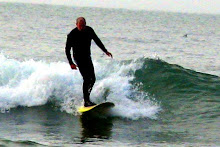
Thursday, December 9, 2010

December 9, 2010 Thursday


Bolinas

Groin

9:40 am to 10:50 am

Consistent 4' to 5', sets overhead

Low upcoming tide

Slight onshore breeze

High patchy clouds and high fog

Good session


Selectivity was the theme for today. Selectivity as in –

“How was it?”

“I got some great waves but I was highly selective.”

The waves were big, powerful, rough and raw. A big swell arrived yesterday, peaked this morning and would be gone by tomorrow. Per the San Francisco buoy the swell was 11 ft at 14 seconds, out of the NW. Stormsurf called it “raw,” meaning bumpy and not clean, and they were right. The ocean was rough, and there were peaks every few feet with steep wind swells on top of the NW ground swells. The weather system that bought in the swells also bought the rain.

“Are you going to the beach this morning? You know that it is raining.” Kate pointed out the raindrops on the skylight in our bedroom at 6:30 am.

“The weather forecast predicted no rain for today, and besides the weather can be entirely different on the other side of the mountain.”

“You’re an optimist.” Yes I am and fortunately I was correct. The rain cleared up as soon as I drove over the ridge at Pantoll and descended down the mountain to Stinson Beach.

Marty was suited up as I pulled into the parking area on Brighton Ave. With camera in hand I accompanied him down to the beach. Marty had decided to go out at the Patch. Twenty surfers were spread across the Channel and the Groin. The waves were big and walled. Six surfers were out at the Patch. The waves broke all over the place, the surface was rough, and the sets were infrequent with no consistent peak. But the inside rights did look good. Marty continued onto the Patch and I went up to the overlook for a better view of the Groin. The waves were cleaner there, definitely peeling left with the north edge of the peak looking like the best spot. Half the crowd was there while all the aggressive short boarders were at the apex of the Channel peak. They screamed down these overhead bombs that always closed out in front of them. The Groin was the call today.

Walking back to the car I met Jeff from Mill Valley who was changing out of his wetsuit. He had gone out at the Patch and caught several good waves. After awhile it became “funky” so he moved inside and over to the peak just north of the ramp. Waves have not broken there in months. To his surprise Jeff got some good fast curls.

I stood in waist high water at the Groin waiting for a set to pass before paddling out. The waves were intimidating. But once through the shore break I could paddle around the peak to the line-up. I did not recognize anyone in the water, which was more proof that this was a big swell. Ocean Beach, Salmon Creek and Dillon Beach must be closed out and thus everyone has come here.

The incoming swells had a ton of water in them. I paddled for one and barely missed it, but I was able to look over the edge and down the line, it was steep. I caught the next one. I had moved closer to the nose when paddling to get more weight forward to push into the wave. It worked. I hung at the top of the wave for a second and then dropped down a head-high face. The wave was fast and had considerable force behind it. I screamed down the line, the wave folded over in front of me, I plowed into the white water and then straightened out. On my second wave, I again dropped down a steep face, turned at the bottom, froze to cruise along the bottom of a fast breaking wave, stalled an instant and dropped into a four-foot shore break. I stepped to the nose and pushed it under water as the wave collapsed on the sand. What a trilling ride. I paddled back out and managed to connect on three more.

With these powerful waves and the tons of white water they produced, paddling out had it challenges. The strategy for getting back outside was to paddle north and out to go around the peak. Easier said than done. After one ride I was near the Groin pole as a big set of waves was coming in. I quickly started paddling north but a sizeable shore break wall was feathering in front of me. It was breaking at the top as I was beginning to paddle up the face. I attempted one of my half-ass longboard duck dives. I moved my body to the front of the board, put my head down over the nose, pushed it under the white water sliding down from the top of the wave and hung on. The wave picked me up and threw me over. I felt and heard a “creak” in my neck as the wave whipped my head out of its tucked position to a straight up vertical position. It lifted up my board, tumbled me completely over and pushed towards the shore. Later on I was paddling out when another big set came through. A close to shore four-foot wall broke in front of me. This time I did a turtle roll. I rolled over, hung on tightly to the nose of the board and waited for the impact of the wave. It picked up the board and flipped it over pulling me out of the water as I hung on. I felt something pull in my left shoulder. Later while driving home, I was nursing a stiff neck and a sore shoulder.

Near the end of my session I went through a twenty-minute lull, not due to the waves, they were still coming through, but due to the crowd and the size of the waves. Several large sets came through that did not look makeable. I couldn’t believe the amount of water in these walls. Nobody else went for them either. Everyone, including me, paddled around for position thinking about going for one but in the end made the rational decision to let them go. Finally a smaller well-formed wall came through. I stroked into it and dropped down an overhead face. It was fast. I climbed to mid-swell and hung on. A short boarder took off ten yards in front of me. With the speed of this wave I easily caught up to him. He was about to cutback, I whistled at him to let him know I was there and he didn’t do it. We both sped down this steep curl until the wave started to come over with force. The short boarder kicked out and I straightened out. The wave was still head-high when I turned. In that instance I decided to go in. With the force of this wave I rode the soup all the way to shore.

As I told everyone after my session, I got some great rides, but I was selective.

Tuesday, November 30, 2010

November 30, 2010 Tuesday


Tribute to Rick Racich

County Supervisor Charles McGlashan read the Marin County Board of Supervisors tribute to firefighter and surfer Rick Racich for his rescue of two sport crab fishermen Sunday November 7th at Cronkhite. I was at the Supervisors meeting and the room was packed, all seats were taken and bodies lined the three walls that surrounded the supervisors’ table. A grateful and humble Rick Racich accepted the accommodation. Twenty firefighters in uniform and standing against the back wall exploded into applause and cheers. Cameras flashed, including mine.

The Chief of the Fire Department and Surfrider Foundation Marin sponsored the dedication. Both groups had alerted McGlashan’s office and suggested that Rick’s heroic deed warranted a county dedication. McGlashan didn’t hesitate and all the supervisors joined in signing the dedication. Rick’s wife, kids and father were there. It was a great feel good moment.

On Sunday November 7th at 9 am Rich arrived with a surf buddy at Cronkhite, his favorite spot. Surf conditions were heavy after the recent storms that had hit Marin: seven to ten foot swells with a four-foot wind swell on top. They had just pulled into the parking lot when they noticed a small craft dangerously close to the rocks and cliff at the south end of the beach. Rick thought these two fishermen were crazy because it was so rough. A couple minutes later Rick realized they were in trouble and their boat was drifting towards the rocks. A park ranger called the Coast Guard while Rick and his buddy suited up. Rick was able to punch through the pounding waves, but his companion couldn’t and had to give up. Rick paddled over to the boat and convinced the frantic occupants to abandon ship. With life vests on they jumped overboard and Rick paddled over to them. All three hung onto Rick’s board and frog kicked their way away from the cliff. Rick managed to move them away from the rocks and get far enough from the cliff to allow a Coast Guard rescue boat to pick them up. The two fishermen suffered a little hypothermia and that’s all. A few moments later the sea crushed their 25-foot Bayliner against the cliff. Rick saved their lives.

As I left the building to return to my car, there was Rick sitting behind the wheel of a huge fire engine firing it up. He casually saluted to his buddies and drove off to return to duty.

Thank God for people like Rick.

FYI – for you who don’t know your Supervisors, in the picture above from left to right are Hal Brown, Susan Adams, Judy Arnold, Charles McGlashan, Steve Kinsey and our hero Rick Racich.

Friday, November 26, 2010

November 26, 2010 Friday


The 2010 Bolinas & Stinson Open Studios

“The hills of West Marin are alive with starving artists.”

Back in September, my surf buddy and good friend, Jim Ellis, had mentioned that he was going show his sculptures in the Bolinas & Stinson Open Studios the weekend after Thanksgiving (see the September 1st Part 2 entry). The past couple of weeks I had seen posters in Bolinas, Stinson and Mill Valley advertising the Open Studios put on by the Coastal Marin Artists. It was a big deal. Twenty-six local artists in their studios to meet, greet, chat and sell their art. So I had to check it out.

Jim has lived and surfed in Stinson Beach all his life. A retired carpenter, he has taken up sculpting of ocean life: sharks, fish, seals, whales, abalone, etc., and he has become well known among the local artists as one of the good ones. Two artist friends, Steve Lewis and Susie Allen de Baker invited Jim to join them at Steve’s studio in Bolinas. Today was Jim’s first public showing where he would be there to chat with the public and he was nervous about it. But after the first few people Jim opened up. All it took was to ask him about how he did each piece. He loved talking technique.

The above photo is one of his wood sculpted sharks. Each piece takes him hundreds of hours of labor. He figures he would be lucky to get minimum wage for any of them.

“Jim how did you get such realistic looking teeth on that shark over there?” This one had teeth that went bent, twisted and some broken off.

“Dentures!” He went on to explain that this one was not a carving but rather was a fiberglass resin compound poured into a mold. For the teeth he did the same thing dentists do for crowns and false teeth, he stuck the shark’s teeth in a small pan of plaster of Paris.

“If you have a mold of this shark, you could crank out several of them.”

“Not really. You see I had to make a series of nine molds, mouth, head, tail, fins, body, etc. I would have to pour each piece, put the pieces together, fit them, smooth them off to make it one piece and then paint it.”

A small shark had washed up onto the beach at Stinson one morning. Jim grabbed it and stuck it in a freezer for a few months. Then with the shark frozen solid he made the nine molds and the dentures, poured in the fiberglass mixture and then spent countless hours putting them all together. Believe me you cannot tell where one piece connects to another.

Jim gave me some recommendations for some of his favorite artists, others that specialize in ocean themes. I spent the rest of the day visiting, chatting with and taking photos of five other artists and their works. I saw seven out of the twenty-six artists, took pictures of six of them, blew the whole day and had a great time. Click on the link below to view my photos. I have pictures for:

Schehera Van Dyk – hand painted ceramics. Incredible detail and bright colors on plates and vases.

Jim Ellis – sculpture of sharks, fish, birds, one whale and seals.

Susie Allen de Baker – Marin hills and coastline acrylic landscapes. Susie has lived and painted in Marin all of her life. She comes from an artist family and has had to fortune to work with some of Marin’s best artists.

Steve Lewis – stone sculpture. Steve carves whale flukes out of granite. It must take him forever to do these pieces. Beautiful, highly polished carvings set in huge blocks of stone.

Jon Francis – Stinson Beach painter of classic cars, beach scenes and old California houses and buildings. Being a graduate of UC Santa Barbara, one building I recognized right away, the old classic Alhambra movie theater on State Street in downtown Santa Barbara.

Michael Knowlton – Stinson painter of beach scenes and other weird stuff. His studio had a ton of large paintings leaning up against the walls. Paintings of the Parkside Snack Bar, stacks of classic old cars in a junkyard, colorful view of the tube of a wave and clowns driving an old convertible. He had a few large paintings of palm trees on fire. As he put it, he painted them after the Los Angeles Rodney King riots where rampaging youths set the palm trees on fire. Several of Michael’s pieces are currently on display at the Parkside CafĂ©.


Bolinas & Stinson Open Studio Photos

Wednesday, November 17, 2010

November 17, 2010 Wednesday


Bolinas

Patch

9:30 am to 10:30 am

2' to 3', sets to 3'

High dropping tide

No wind

Warm sunny day

Fun session


I didn’t have much time this morning. On Wednesdays Marty and I collect water samples at Bay Front Park in Mill Valley, Stinson Beach and Brighton Beach in Bolinas for Surfrider Marin’s water testing program. I collect the Mill Valley and Stinson samples, Marty takes the Bolinas one and after a morning surf session Marty drives the samples to the Branson School, which is near his house. Jamie the environmental sciences teacher and a team of student volunteers run the tests, which require an eighteen-hour incubation period. This morning Marty couldn’t make it, thus I had to make the hour drive to Branson. The samples have to be there around noon for the students to begin the tests during their lunch hour.

I arrived at Bolinas late (9:15 am) and figured that I had to be on the road by eleven, thus I had one hour for a short surf session. It was a beautiful day, Mary and couple other regulars were already out at the Patch. Surf forecasts were ok: 10.8 ft NW swell at 12 seconds combined with a 2 ft south swell at 18 seconds. It looked like the south swell was hitting the Patch, and I needed the exercise thus I decided to go. I would make it a sprint; paddle like mad and get in as many waves as I could in one hour. To my surprise the waves were small but fun despite the high tide. In one hour I connected on five well-formed long right waves, ones that kept reforming and reforming. It turned out to be a short but fun session.

That’s me in the above photo. Near the end of a long ride, way on the inside, I saw Mary sitting on her board pointing a camera at me. Note the sunshine, glassy surface and the long line of the swell. Mary had just recently begun taking pictures in the water. She told me it’s harder that it looks. Capturing a good shot takes luck. Both the subject and the person with the camera are moving. The camera doesn’t have a viewfinder, only a 2.5-inch square LCD screen that shows the image and thus is constantly changing. With bright sunlight and no sun glasses framing the shot is pure guesswork. As Mary put it, she points and hopes. She has numerous photos of sky and blurry water, but still a few turned out well and are worth the effort.

I too have thought about taking pictures in the water. The surf magazines are filled with incredible in-the-tube side views taken in the water. A small inexpensive camera would be fun. I have seen a few guys in the water with the new Go-Pro waterproof digital cameras. Mary has the Pentax OPTIO WS80 waterproof camera. I looked up its stats online; here’s what Pentax claims: palm size body, high-quality, high-resolution image (10 megapixels), optical 5X zoom lens, airtight body that allows taking of pictures underwater to a depth of 1.5 meters for up to two hours, and it features Pentax’s exclusive highly water-repellent coating on the glass in front of the zoom lens. Simple fresh water removes dried salt, dust and dirt. They retail for $275 from Amazon.com.

Mary told me that this was her second one of these cameras. Her first one she had dropped in the water. She had just purchased it and was getting using it. She was standing in waist high water on the rocks at the Patch. She pulled the camera out from beneath her wetsuit and before she could put the cord around her neck she dropped it in the water. It sank and due to the murky water Mary couldn’t see it. She frantically jumped around doing the chicken stomp trying to feel for the camera with her feet. The camera had disappeared and after a few minutes she gave up. She soon purchased another one and now always ties the camera around her neck before tucking it inside her wetsuit.

The real reason Mary purchased a waterproof camera was to capture images of sunlight on the ocean’s surface. Mary is an artist and she has been studying for several years the patterns of light and color on the water and has been trying to reproduce them in her paintings. She has become very skilled at capturing the images of the ocean. Don’t take my word for it. Check out her website (link below) and see for yourself. You will be impressed.

Mary's website

Monday, November 15, 2010

November 15, 2010 Monday


Bolinas

Groin

9:00 am to 10:15 am

1' to 2', sets to 3'

High outgoing tide

Strong offshore wind

Bright sunny day, heat wave

So - so session


Changing weather and strong currents were today’s themes. Since last Wednesday high pressure had settled in, locking in a layer of warm air and creating offshore winds. The high pressure was beginning to break up and low pressure and cold air will begin moving in tomorrow. The shift from high to low pressure has produced a wind gradient of strong north winds that are offshore at the south-facing Bolinas. Today would be the last day of the heat wave. The Internet surf data was mediocre: 7 ft north swell at 10 seconds from 315 degrees combined with a one-foot south swell at 12 seconds from 195 degrees, strong north winds and a high dropping tide.

Two groups were out at the mouth of the lagoon this morning. Six surfers were straight out from the Groin, including Marty, Susan who always wears sunglasses in the water and Novato Pete. The other group was over at Seadrift going for the rights. The Seadrift side looked good, the offshore wind was holding up the waves as the surfers cruised down long fast peeling rights. Over there were David who rides the Becker board, Jack the Dave Sweet team rider and stand-up surfers Frank and Russ. That’s David on a set wave in the above photo.

“Jaime how was it?” Jaime had just exited the water at the Groin.

“It was fun. I got some good rights over on the Seadrift side. Long waits between sets followed by several good waves. The wind has picked up and the current has started.”

Because the weather was so good I had to go out. Paddling out to the Groin I saw Marty drop down a well-formed small left wave. The waves were beautiful, deep blue water, silvery sun reflection on nicely shaped peaks that were held up by the offshore wind causing arches of spray to come off the tops. Despite the beauty, the waves were weak. On my first wave, I paddled towards the peak, stroked into the wave, faded right, swung around left and dropped down a three-foot face. At the bottom, my momentum died, the wave broke in front of me and I didn’t have the speed to push back into the swell. The wave broke into a “dead-zone”, a patch of deeper water that caused the wave to peter-out. Only the bigger set waves had enough force to enable us to cross the dead-zone.

The ebb-flow out of the lagoon was deceptively strong. Marty, Susan, Pete and I sat outside quietly chatting while waiting for the next set that never came. We didn’t realize that we were moving. I took a quick check of the shore. We had started out south of the Groin pole and in a few minutes we were north of the pole and further out. I started paddling in and to the south. My strategy for dealing with current is to stand in the water. While paddling in I would stop and test the depth of the water. I made five such depth tests before reaching a point where the water was chest deep and I could stand there. The current was strong; I could feel it pushing against my body and my feet. My strategy worked. I would stand in the water, watch for a set and then paddle for position when the set arrived. The ebb current started slow and continued building momentum. By the end of our session, a river was raging through the impact zone. The current knocked down the waves and created an annoying ripple on the surface.

Despite all of this, Marty, Susan, Pete and I managed to catch a couple of decent waves. After one ride I turned to paddle back out and here came Marty on a good wave. He managed to cross the dead zone and connect with the shore break. This had him heading straight for the Groin pole. He bailed out five feet in front of the wall and the surge of the wave carried his board into the pole. “Bonk!” It crashed into the pole with some force. Fortunately no damage occurred.

After our session, Marty and I chatted with Yaschik, the excellent surfer who always goes way outside and sits cross-legged on his board. We were admiring his shortboard. It was well made, solid and had a large single fin glassed into the board. Nowadays most shortboards have three small fins that are removable. Yaschik mentioned the shaper who we didn’t know, but is well known in the shortboard world. Marty told me that Yaschik owns over sixty surfboards. He confirmed that. Most are shortboards with a few classic longboards, such as a 1963 Hansen and two Donald Takaymas in mint condition.

“Why do you have sixty boards?” I asked. “For collection to display?”

“No to ride them. But I do need to sell some of them.”

From what he described they are all specialty boards, classics, and works of art; not your run of the mill surfboards. So we’ll keep an eye out for when and where he puts some of them up for sale.

Wednesday, November 10, 2010

November 10, 2010 Wednesday


Bolinas

Groin

10:00 am to 11:30 am

3' to 5', sets overhead

Low upcoming tide

Gusty offshore winds to no wind to offshore breeze

Sunny, windy and clear

Good session


I didn’t have big expectations for waves this morning. Last night it rained and the wind was howling in Mill Valley when I woke up. I thought the ocean would need a day to settle down before the waves got good again. The Internet data was ok, not spectacular: 7 ft NW swell at 11 seconds, light north winds, sunshine and an upcoming tide. I had to go because I had to gather water samples for Surfrider’s water testing program. Six surfers were at the Groin when I arrived, including: Marty and David who rides the Becker board. Hans, Jaime and one other were at the Patch. The waves at the Groin were beautiful, smooth surface, glassy peaks, and a strong offshore breeze that sent arches of spray off of the tops, but they were infrequent. With camera in hand I waited and waited for someone to catch a wave. However, it was such a beautiful day I had to go out.

“Hey Loren, did you bring your wetsuit today?” Russ shouted at me back at the cars.

“Yes I did.”

Last Monday (November 8th) Russ witnessed my frustration when I started to suit up and discovered that I had left my wetsuit hanging on its hook in the garage at home.

“Loren, this morning I started up the car, began to back out, then turned off the engine, got out and went around to the back to make sure I had my wetsuit. I was thinking about you.” Russ and I are about the same age, that age where you have to make lists to insure you won’t forget something important.

Dexter walked by heading for the ramp. He was dripping wet and was carrying a shortboard.

“Dexter, you’re wet. Were you out there already? How was it?”

“I’m changing boards. I’m switching from my 9’ 8” to my 6’ 3” brand new John Moore Mystic shortboard.”

“So Dexter, where were you during the big swell last week? I didn’t see you here.”

“Scorpion Bay,” he said grinning from ear to ear.

“Mexico?”

“Yes, It was so nice. Hot, sunny weather, great waves, warm water, no crowds and no wetsuits.” Scorpion Bay is on the Baja Peninsula, 600 miles south of San Diego. Dexter drove there by himself, a two and a half day journey. He slept on the beach and scored some classic surf.

“I howled when I got back and struck my toe in the water here!”

Walking down the beach to the Groin, a set of perfect waves came through. They looked bigger than before and better formed. With the upcoming tide the waves had improved. I paddled out to join Marty and Dexter, David had moved to the Seadrift side to try the rights. I couldn’t believe the quality of the waves. The offshore wind caused them to stand straight up and then pitch over into nice little tubes, and the bottom forced all the waves to peel to the left. On my first wave I took off late as the lip was pitching over. I dropped down a steep head-high face that curled and broke in front of me. The wave had power; I leaned into the white water, struggled to keep my balance and pushed back into the swell. The wave stood up again and I shot through a steep fast inside curl. I continued on until it closed out near the Groin pole. What a great start to a session.

Both Dexter and I paddled for a big set wave. I missed it but Dexter caught it. From the back I watch him disappear. The face was over his head. Way on the inside he popped out, cut back, turned back into the curl and continued on. What a great ride.

Chuck the Bolinas local who rides a kneeboard paddled out to the outside peak. Chuck is an excellent surfer, and he doesn’t bother coming out unless the waves are good. I used him as my indicator. He knows the break, thus if he paddled out, I paddled out. If he paddled laterally, I paddled laterally. When the sets came, Chuck would take the first wave and I would quickly paddle over to his take off point and catch the second wave of the set. This strategy worked for at least five good rides. One time I was deeper in the peak than Chuck. I took off and the wave quickly broke in front of me. Chuck had taken off on the shoulder and cleanly made the initial drop. I continued along in the white water hoping to push back into the swell. I got a perfect view of Chuck’s ride. There he was locked in the inverted “L”, that point where the lip and the white water intersect, on his knees at the top of the wave, spray coming off the top, white water pounding behind him and the curl feathering ten feet in front of him. He skillfully shot down the curl, cut back, turned sharply left and shot through another fast section.

Yaschik, another excellent surfer, was out at the far peak. Yaschik is in his mid-thirties (my estimate), has tattoos up and down both arms, is from Poland and has lived several years in San Diego, where he learned to surf. He is a regular at the Patch, on a longboard with no leash and usually goes way outside and north of the rest of us and sits on his board cross-legged while waiting for the sets. This morning he was on a shortboard, again way outside, sitting cross-legged. I had just completed another good ride, turned around to paddle back out and saw Yaschik coming down a perfect wave. It was a foot over his head, an emerald green swell with sunlight pouring through the back with Yaschik silhouetted against the wall of water locked mid-swell in the curl screaming down the line with the roar of the pounding wave in my ear. He crouched down with his back to the wave, put his hand on the outside rail, hung on as the lip slapped him on his shoulder, he cruised out into the swell again, stood erect and sailed down the beach. It was a picture worthy of all the surf magazines.

At eleven David paddled back from the Seadrift side to join us. “When did you come out?”

“I entered the water with Marty at a quarter to eight.” At eleven thirty I went in and David was still out there. I changed, went into town for coffee and when I returned here came David.

“Time check. It’s 11:47 am. That’s four hours in the water.” He admitted that he finally came in because he was tired and hungry and that it was lunchtime. Now that’s the surf passion.

Friday, November 5, 2010

November 5, 2010 Friday


Bolinas

Groin

9:15 am to 11:10 am

3' to 5', sets overhead

High tide (6.8 ft at 11:00 am)

No wind

Overcast

Good session


Conditions were good this morning. The last remnants of the first big north swell of the season mixed with a little bit of south swell: 6 ft NW swell at 13 seconds, 3 ft south swell at 14 seconds, no wind, upcoming tide and glassy conditions.

“Hey Loren, watch out for the flotsam. It’s dangerous out there,” Dan greeted me as he came up the ramp.

“The what?”

“The crap in the water. I almost hit a log floating in the water at the Patch.”

The power of the ocean is always amazing. The big swell of this past week had deposited mountains of debris on the beach and had removed tons of sand. A major section of a pier lay on top of the sand berm near the high tide line. A twelve-foot long 9 x 9 inch beam connected two telephone size pilings. This thing had to weigh two tons. How could the ocean push a thing of this size around? There must be a good story here. Where did it come from? How far did it travel? Did a storm literally destroy a major pier? And how long had it been in the water? Several small tree trunks and large pieces of weathered plywood surrounded the pier section.

I paddled out at the Groin to join Martha and Sarah who drives the gold Mercedes. David who rides the Becker board and Mark the archaeologist were further south at the Channel peak. The waves were much bigger and more powerful than they looked from the overlook. I knew they were difficult to catch so I sat inside to take off late. A good wave was cresting when I turned to go for it. I stroked into it as it was breaking, dropped down a head-high wave, fizz sounded from my rail cutting into the curl, I turned left and looked down a line that was feathering ten feet in front of me. I leaned into it, crouched down and shot through the first section and pushed out onto the shoulder. I cut back into the breaking part of the wave to let it build up, turned left again into a fast inside curl and cruised along until the wave sucked out near the Groin wall. At that moment I knew I was in for an exciting session.

The waves were steep, powerful and fast. But there was a dead spot in the middle of the break that was both positive and negative. Positive in that the dead spot, which was an area of deeper water, caused all the waves to break to the left. The initial peak would pitch over and peel towards the deeper water. The dead spot also provided a good channel for paddling back out. The negative was it was truly a dead spot. I would sail down the initial section and coast into the dead spot where my momentum and the wave would die. I learned quickly that I had cut back into the breaking part of the wave after the initial drop to stay in the wave. If I could stay in the wave, it would reform into a steep and fast inside curl.

A skilful stand-up surfer, who was always paddling around way outside at the far Channel peak, became my indicator. If he started paddling further out I knew a set was coming. A big set approached, I considered going for it, and so did another surfer and the stand-up guy. The other surfer and I pulled back to let the stand-up guy have the wave. As I paddled over it, I got a good view of the stand-up surfer coming down the wave. He dropped into an over-head wall, water sprayed off the top, he sharply turned left with his back to the wave, the lip which was two feet over his head pitched out over his right shoulder. He sailed down this perfect peak for fifty yards before the wave finally closed out in front of him. Later after a good ride, I stood in waist high water and watched this guy come down another beautiful wave. Magazine picture perfect, he was three-quarters down the face, crouched down with his paddle straight back looking like the rudder of an airplane as he sailed across another fast left peeling wave.

After riding a smaller wave, I got caught inside. Wave after wave kept coming in and I had to plow through all of them. When I finally got back out to the line up I mentioned my struggle to David.

“You didn’t follow your own advice,” David exclaimed. “You should never take the first wave of a set because you’ll have to paddle back out through the other waves.”

He was right. I have often written about that in this journal and I didn’t do it, again. David mentioned that he too had to struggle to get back out. He cut right on a wave and rode it into the Channel. Now he was paddling against the incoming waves and a strong current due to the incoming tide. That was the last right wave he took that morning.

David had a good session. He has the ability to paddle into flat waves, more so than I can. Once when paddling back out, I watched David stroke into a beautiful head-high glassy wall. He dropped to the middle of the swell, crouched down, cruised through the first section, cut back and turned into a fast, long inside curl. David had entered the water at eight and got out at eleven-thirty, three and a half hours. I could never last that long.

The six-foot high tide presented some challenges. Water pushed up the ramp, waves crashed against the retaining wall of the house at the base of the ramp shooting water and spray skyward and creating a backwash to collide with the incoming waves. Going out, I ran in front of the wall when the water began to recede. Halfway there a wave came in, crashed against the wall and the backwash knocked me down. Out in the line-up, I kept watching the waves crashing against the wall. Getting in was going to be tricky. I watched another surfer with board tucked under his arm run in front of the wall and make it. If he can make it, so can I. It wasn’t so bad, though it one point I was in waist deep water bracing myself against the backwash.

All in a day’s work I said to myself, and what an exciting morning it was.