Friday, October 14, 2011

October 14, 2011 Friday


Bolinas

Channel

9:20 am to 11:00 am

2' to 3', sets to 4'

Mid upcoming tide

No wind

Sunny and warm - heat wave

Fun session


"Jacek, what's that? A kneeboard?" He was waxing up a small thick, pointed nose, double tailed board. It looked brand new. Jacek has a quiver of sixty boards, and depending on conditions he often brings a different board to the beach. This board looked like the one that Chuck the local kneeboarder uses.

"No, I stand up on it. Here check out my other one." He pulled out another similar small board out of his car. "Both shapers were protégés of Skip Frye. These boards originated in San Diego. They are CLASSIC FISH boards," he proudly announced. Ship Frye was a renowned shaper from San Diego in the sixties. Both boards had two points in the tail with a big Vee between them and six inch glassed on wood fins positioned on each point. They were also thick (nearly 3 inches) and wide - 22 inches.

"Jacek, this board looks brand new." It didn't have a mark on it. "No it's not." He flipped it over and pointed to the year penciled in the stringer along with the other dimensions. "See, 2004! It's seven years old, but it has hardly been used."

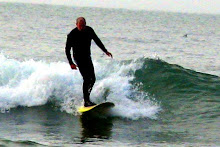
Jacek certainly didn't have any problems riding his fish. He did his usual thing of sitting at the furthest peak and waiting for the sets. The waves were small, flat on the take-off and peeled continuously to the left. To me these were longboard waves. Jacek waited until the waves were cresting, then he dug hard with his head hanging over the tip of the nose, jumped to knees when the waves picked him up, pushed the nose over the edge to insure he was in them, jumped up to his feet and then cut up and down the curls as if he was on a skateboard. Yes he had no problems with this board. That's him in the above photo on his fish.

Back home after my session I looked up "fish" in Matt Warshaw's The Encyclopedia of Surfing: Stumpy, blunt-nosed surfboard design invented by San Diego kneeboarder Steve Lis in 1967, featuring low-rocker and a split tail and later adapted for stand-up surfing that was recognized as a small wave speed machine. Jim Blears of Hawaii used a 5' 10" fish to win the 1972 World Champions - held in sloppy surf in San Diego. In 1976, Australian world champion Mark Richards modified the design to produce a version of the twin-fin that became a surf world best seller.

The weather was the story today - a classic October Indian Summer day - heat wave, clear skies, warm water (57 degrees), no wind and tabletop glassy smooth surface. Only negative was the red tide. The water had that Te Java ice tea look. It was the same red tide that has been hanging around for the last two weeks. The swell was 5 ft at 12 seconds, which resulted in two to three-foot waves at the Channel. While taking photos I watched David who rides the Becker board and Marty catch some nice clean left curls. Mary and Mark the archaeologist were on the far side of the Channel going for the rights. No one was at the Patch.

Back at the cars, Hans was changing after his session at the Patch. He had a great time and had it all to himself. He didn't understand why no body else out there with him. Work had kept him from surfing for a couple of weeks and it felt great to be back in the water and his arms were feeling it.

I paddled out to join Professor Steve and David at the north edge of the peak. Both of them immediately caught waves. I looked outside and a set was approaching. I stroked into the second wave, jumped up to my knees, leaned on the nose to push into the wave, jumped up to my feet and cruised down a long mellow left curl. What a good start to my session.

The regulars were out there and all of them glided into several mellow waves. Marty caught his share. David as usual just continuously paddled into one wave after another and was still out there when I exited the water. Francine sat on the inside and connected on several waves. Mark drifted back over to our peak and cruised down several long lefts.

Annette and her partner were out there on their stand-up boards. These two know what they are doing and they were all over the place. They drifted over from Seadrift, riding waves all the way. Today conditions were ideal for stand-ups - gentle, flat take-off waves, frequent sets and long rides. They worked their way over to the apex of the furthest peak to join Jacek, drifted over to our peak for several waves and then reversed course. When I exited the water they were a half-mile down the beach at Seadrift.

What a beautiful day. After an hour and a half I ran out of gas and went in. Mary and Marty were back at the cars. After three-hour sessions they were talking about going out again. It was just talk; they didn't do it. But it was that kind of day that makes you consider staying out all day.

Wednesday, October 12, 2011

October 12, 2011 Wednesday


Bolinas

Patch

10:20 am to 12 noon

3' to 4', sets to 6'

Mid upcoming tide

Slight onshore breeze to no wind

Sunny and warm

Good session


The NOAA weather radio announced this morning at 6 am that the Point Arena buoy was 15 ft at 17 seconds and the San Francisco buoy was 7 ft at 17 seconds. Those were Maverick's size swells. Also the wind was NW at 5 knots and the water temperature was 58 degrees. The weather had changed. Monday a small front came through and shrouded the whole coast with dense fog, south winds and drizzle. I went to Bolinas and didn't bother going out and went for a jog at Stinson instead. But today high pressure had settled in, the cloud cover was gone, the sun was out, the wind had died and the swell was big. My hopes were up for some good waves.

From the overlook above the Groin, fifteen surfers were bunched together at the only rideable peak - half way between the Channel and the Groin. The waves were big and closing out. I watched one surfer after another drop down an overhead faces into a ton of white water. I didn't recognize any of them and it didn't look inviting.

From Terrace Road I saw fifteen surfers spread across several peaks at the Patch. The waves were smaller and mellow. Several of the Bolinas regulars were there. David who rides the Becker board, Shu-Shu and Martha were going for the rights on the inside. That's David on a good one in the above photo. Marty, Mary, and DB the Safeway checker were 50 yards north going for the lefts and Ray the Petaluma fireman, Russ the stand-up guy and a few others were outside at the furthest peak. All the rides were slow, gentle, long and infrequent. But that looked like a lot more fun than the pounders at the Channel; I would head for the Patch.

David and Marty had started at the Channel and had moved to the Patch. Marty told me that the waves were powerful and that he was humbled. Marty and a shortboarder took off on the same wave and collided causing a side fin on the shortboard to snap off. Both were cordial, no angry words were spoken, but it was then that Marty decided to move to the Patch where he had a great session. David mentioned that he got skunked at the Channel due to the number of shortboarders. Like Marty, David paddled to the Patch where he connected on numerous good waves. Ray usually goes out to the Channel and often over to the Seadrift side to be by himself. This morning he arrived before dawn, couldn't see a thing and thus followed Russ and DB out to the Patch.

Next to me while suiting up was Leonard from Santa Rosa. He introduced himself. Like me he was retired and about my age. He hadn't surfed in six months and was anxious to get back into the sport. He told me about the old days of growing up in Marin. He graduated from Redwood High and the College of Marin and rented a room on Brighton Avenue in the sixties to surf and go to school - in the days before wetsuits, booties and leashes. We entered the water together and hung out at the same peak. For someone who hadn't surfed in six months, Leonard connected on several long rides. Afterwards he felt great about his session.

The waves were good but not exceptional and at first I floundered around and the crowd impacted wave selection. After an hour things improved: the crowd left, I don't why, the wind stopped and the surface glassed off. Suddenly only four of us were out there - Lea, Leonard, one other guy and myself.

The other guy, who was an older gentleman about my age, had a great session. He sat twenty yards further outside and patiently waited on his big, thick, no-rocker paddling machine for the big sets, where he managed to catch all the big ones. I was amazed at how he could get that big board moving to push into these waves just as they peaked. He would fade into the peaks, swing into the curls when the waves broke and would coast down the faces for a long ways. He did this time and time again. Lea also had a good session. She is a Bolinas local and knows the Patch well and has that instinct to anticipate where the waves are peaking, and today the peaks were moving around. Several times she stroked into sizeable waves, skillfully dropped down the faces, cut back into the breaking part of the waves and swung around into reforming curls.

I started out slow but towards the end of my session I began to connect. After an hour and a half my arms were beginning to feel it. I figured I would go for some rights to work my way in. I was sitting inside of the others when a beautiful set wave came through. The others didn't go for it, thus I swung around quickly and dug hard to get into it. The wave picked me up; I jumped to my knees and leaned on the nose to push the board into the wave. I jumped up to my feet and looked down the line of a perfectly forming head-high wave. I cut right, climbed high in the wave, stepped to the middle of the board and trimmed through the first section. I cut back, stalled for an instance to let the wave build up, swung right again and flew down another section. The wave jumped up and broke in front of me, I crouched down, planted my feet and hung on while I drove under the white water and climbed back into the swell. The wave stood up again and I locked my inside rail under the lip and flew down another fast section. I cut back and the wave died ten feet from shore. What a great way to end a session.

Friday, October 7, 2011

October 7, 2011 Friday


Bolinas

Patch

8:30 am to 10:20 am

Consistent 3' to 4', sets overhead

High tide - 5.3 ft

NW cross breeze

Sunny and clear

Good session


"Loren, your face is all red and you're bloodied. What happen?" Jack the Dave Sweet team rider noticed my wound as I was changing after my session. Marty and Mark the archaeologist were also curious.

"I got clobbered on my last wave. Often I would catch the white water to get into the waves while they reformed. A big wave broke in front of me and I turned and stroked into the white water. It was big and buried me. I was traveling along at great speed, I jumped to my knees, tried to maneuver over to the swell, and as I went to stand up my hand slipped off the right rail and the board turned upright and my jaw slammed into the rail."

I didn't tell them, but it hurt. I was stunned and immediately checked to insure all my teeth were there. I wiped my jaw and had blood on my hand. Time to go in.

"You're the second one to do that today," Jack exclaimed. "Doug did it too. He had this big gash under his eye. But it was the same thing - his hand slipping off the rail as he was jumping up."

"Well you guys are always razzing me about too much wax on my board. But see, I didn't have enough."

"No, you got that wrong. You just need to put it in the right spots." That was Jack getting in the last word. I rub wax on my board before every session and never clean it off, thus I have a two-year build up of dirty black and gray wax covering the deck of my board. However, there were two places with little wax, right where my legs wrap around the rails when sitting waiting for the waves. Those two spots, which are located at the midpoints of both rails, are where I place my hands when jumping up.

Once home I exchanged emails with Doug about his experience. Here's a summary of what he went through this morning.

Scott who only surfs on Wednesdays and Doug were alone on the Seadrift side of the Channel scoring on lots of chest to shoulder high rights. After an hour Scott said he needed to get to work and was going to take one more and go in. Doug concurred. Scott connected on a long left that took him all the way in to the Groin area. Doug caught another good right and decided to go back out to connect with a left. A good size wave came through and Doug paddled at an angle to get into it. As he moved to stand up his left hand slipped, the board rotated and his face slammed into the rail. There was blood all over his board, and since he was alone 400 yards from the Groin pole he couldn't assess the damage. When he reached the parking lot, Scott, Russ, Mary and Dan checked him out. He had a two-inch laceration on his right cheek. With the help of a car mirror, Doug opened up the cut to clean it out. He thought that he could get by with a couple of butterfly bandages, but it would not stop bleeding. By the time he got back home in Petaluma, it became evident that as soon as he took the pressure off the wound, the blood would start flowing again. Doug went to the Kaiser emergency center where they did him up with eight stitches and told him to stay out of the water for a week.

In Doug's own words, "Thank God, it was my last ride. It would have really been irritating to have something like that ruin a good session." Spoken like a true surf warrior.

By the way, the surf was good today. Both Doug and I had good sessions. I was out at the Patch where a few overhead sets came through. That's Jack in the above photo on a good inside curl at the Patch.

Monday, October 3, 2011

October 3, 2011 Monday


Red Tide Hits Marin

The surf this morning at Bolinas didn't look inviting so I kissed it off and went for jog on the beach at Stinson. All along the beach from the park to Seadrift, the water was a murky red-brown. The red tide was in and it was thick. We have seen the red tide for a couple of weeks now. After my run, I went back to the car and got my camera and took a few pictures. The red tide was especially prevalent near the main parking lot of the park. At home I jumped on Google to learn more about this phenomenon. Here's what I found.

Wikipedia - definition: common term for a phenomenon known as an algae bloom. The algae phytoplankton are single-cell plant-like organisms can form dense visible patches near the water's surface. The dinoflagellates or diatoms species of phytoplankton contain pigments that vary in color from green to brown to red. When the algae are present in high concentrations, the water appears discolored, often a reddish-brown color. Harmful algae blooms are those that produce natural toxins (Karenia brevis most common marine algae of this type) or deplete dissolved oxygen in the water, both of which can kill marine organisms, coastal fish, birds and mammals.

Occurrences of red tides are usually seasonal resulting from coastal upwelling or natural movement of ocean currents. The growth of marine phytoplankton requires relatively warm water and the availability of nitrates and phosphates, which can be abundant in agricultural run-off as well as in coastal upwelling zones.

Thread Starter 9/2/11 (a publication for the serious sports fisherman): A large number red abalone and sea stars deaths have been reported, the California Department of Fish and Game said yesterday. The department has confirmed reports of dead sea creatures in Bodega Bay, Russian Gulch, Fort Ross, Timber Cove and Salt Point State Park since Saturday (8/27/11). The deaths coincide with a local red tide bloom and calm ocean conditions, which may be the reason for the invertebrate die-off. An exact number of deaths has not been reported, however abalone fishermen are advised to contact a doctor if they feel sick.

The Press Democrat 9/15/11, "State Cancels Sonoma Coast Abalone Season" by Sam Scott: The California Fish and Game Commission has ended the abalone season in Sonoma County, more than two months before its scheduled conclusion. The emergency decision follows the death of an untold number of shellfish, which began washing up on local beaches on Aug 27. Scientists suspect the die-off of abalone, chitons, sea stars and other invertebrates resulted from an explosion of plankton that bloomed around the time the deaths began. It remains unclear if the red tide suffocated or poisoned the animals. But the results have been stark. This week state divers reported that 30 percent of the abalone found in samples taken in Fort Ross area were dead, as were 25 percent of the abalone at Timber Cove and 12 percent at Salt Point.

"There were more abalone dead on the rocks than I have ever seen on the water," said Bill Mashek, a local diver of 30 years. "The population has been devastated. Further hunting is only going to devastate it more."

The emergency closure is limited to Sonoma County. Waters off Mendocino, Marin, Humboldt, and Del Norte counties remain open through Nov 30, the normal end of the season.

Central and Northern California Ocean Observing System (CeNCOOS) website: Breaking News! Major bloom of toxin producing dinoflagellate, Gonyaulax spinifera, documented in Bodega Bay and surrounding coastal areas between Pt Arena and Pt Reyes in late August through early September. The bloom is possibly continuing in some areas of the north coast as of 9/22/2011. This type of bloom is very uncommon and the impacts of the toxin (called yessotoxin) on marine life and people using the ocean are uncertain. Partially coinciding with the bloom was a huge die-off of marine life from approximately 8/20 - 9/4. Apparently limited to invertebrates, dead abalone, crabs, urchins, chitons and seastars washed ashore on north coast beaches in large numbers. It is still unclear whether the algal bloom is linked to the die-off. Other potential causes for the die-off include viruses or bacteria.

CeNCOOS is one of eleven regional associations within the Integrated Ocean Observing System (IOOS) around the nation dedicated to the support of science in the service of marine ecosystem health and resource sustainability.

Marin IJ 11/27/11 "Spread of Toxic Algae Blooms a Growing Concern" by Peter Fimrite. (Thanks to Marty for broadcasting this article to the Bolinas regulars). Marine scientists are trying to find out why previously unknown blooms of toxic algae are suddenly proliferating along the California coast, killing wildlife and increasing the risk of human sickness. The mysterious blooms have recently been bigger and have occurred more frequently than ever before; an alarming trend that a team of scientists led by UC Santa Cruz is attempting to figure out.

"It is a huge problem for wildlife," said Raphael Kudela, a professor of ocean sciences at UC Santa Cruz and the lead scientist for the study, which began last week. "We've seen a lot more of what we consider unusual events. It's not always the same organism, but new things keep cropping up. The million-dollar question is: What exactly is the change in the environment that these things are linked to?"

The danger was disturbingly apparent starting in August when a deadly red tide killed tens of thousands of abalone, sea urchins and other mollusks along the coast in Sonoma and Mendocino counties.

Scientists will deploy an array of sophisticated ocean-monitoring technology, including robotic gliders, a network of underwater sensors and satellite observations, during the five-year, $4.3 million study. The project shoved off using an $800,000 grant from the National Oceanic and Atmospheric Administration (NOAA).

Scientists will also try to determine whether climate change is having an effect on the size, frequency and location of deadly algae blooms. "We can't say for sure that it is tied to something like climate change," Kudela said, "but it does seem to be spreading globally, so something is changing, and we are trying to find out what that is."

Algal blooms are already known to be relatively common in the coastal waters of Oregon, Washington state and Canada. Recently, though, unusual toxic algal blooms have also been detected in the Gulf of Mexico, off the coast of Alabama, South Carolina, Florida, in Chesapeake Bay and the Gulf of Maine, according to researchers. Future outbreaks may be unstoppable, Kudela and others admit, but they hope the study will eventually help them develop a computer model that will predict blooms before they have a chance to cause havoc in the marine environment.

Wednesday, September 28, 2011

September 28, 2011 Wednesday


Bolinas

Groin

10:00 am to 11:30 am

4' to 5', sets overhead

Mid upcoming tide

Onshore breeze to no wind

Sunny and hot - heat wave

Fun, yet frustrating session


With a Maverick's size swell during a heat wave, I had high expectations for waves this morning. The NOAA weather radio reported 14 ft NW swells at 15 seconds - that's big enough to cause Maverick's to break. The radio also forecasted 85-degree high for San Rafael, the closest location they list to Marin's beaches. Now I was excited - hot, sunny, no wind and a big swell. Bolinas should be good and it will be crowded. With big swells, Ocean Beach and Salmon Creek close out, thus the regulars at those beaches come to Bolinas. All the parking spots around the tennis court were taken, and I had to park half way to the Post Office.

Fifteen surfers were out at the Channel and Groin going for big, overhead hard breaking lefts. Waves crushed riders once they dropped down the faces. The Patch also had fifteen surfers, including Bolinas regulars Mary, Jack the Dave Sweet team rider, Marty and Hank. Unlike the Channel, surfers at the Patch were spread across several peaks, but the waves were slow with no push behind them and with the tide coming up the Patch waves would become slower. Thus I decided to head to the Groin.

Heading back to the car after taking pictures, I ran into Ray the Petaluma fireman after his early morning session.

"Ray how was it?"

"Too many idiots and not enough waves," Ray had a frustrating session. "What's this 'on your left, on your right?' What are they doing on my wave?"

While suiting up, Frank the stand-up guy drove by, stopped and rolled down the window."

"Frank, what's the report?"

He shook his head, "When we first arrived it looked great and we got all excited. But the waves were bumpy and infrequent. But I think it is getting better." Frank also had a frustrating session.

Rob, Mr. Throwback, and his good friend Greg were suiting up across the street. I hadn't seen Rob in a long time.

"Rob, Stinson Beach must be closed out for you guys to come here."

"You've got that right. How are the waves?"

"The Channel waves are great, but so is the crowd." We walked down the beach together and while I strapped on my leash I told them my strategy to go for the fast inside waves at the Groin.

"I like that idea, keep it quiet," Rob commented as we entered the water. "Boy the water is warm."

"It's colder than Monday. I think the big waves are stirring up the bottom." What was I doing? Here I was talking to Mr. Throwback, a time warp from the sixties. Rob and I have similar backgrounds. We both grew up in the South Bay of Los Angeles. Rob learned to surf at Hermosa Beach in the early sixties and here in 2011 he has not changed. There he was bald headed with no wetsuit, no booties, no leash, riding a sun-yellowed beat to shit longboard with one big glassed on fin. The only protection against the cold was his faded Aloha trunks. He calmly jumped to his knees and paddled out to the line-up. I saw him several times at the furthest peak stroking into overhead waves.

Over twenty surfers were in the water when I paddled out and I didn't recognize any of them except Jacek the tattoo artist. He was on a medium size board with a pointed nose and pintail and no leash. He paddled over to say hi. Work called thus he was working his way in. He was having a great time. A good size wave came through and he was on it. I watched him closely. He waited to the last moment before paddling for the wave. A little wind swell jumped up on top of a ground swell. He stroked hard two to three times and coasted down the wind swell, gained momentum and then dropped over the edge of the ground swell. "That's how it's done," I said to myself. Catch the top portion of the wave - a technique I executed several times this morning.

I struck to my plan to go for the inside line-up at the Groin and thus avoid the crowd. I had minimal success. On my first wave I dropped down a head-high face, cut left, climbed back into the swell. The wave stood up and I thought I was in for a fast curl ride. But I was headed straight for the Groin pole. With a six-foot high tide the Groin wall was submerged and the Groin pole stood erect in the impact zone. I dove off to avoid hitting the pole and the surge carried me a long way in. When I surfaced I was ten yards on the north side of the pole looking straight at it. My board was floating on the surface on the south side of the wall. Thinking I was above sand, I put my feet down and 'klunk' they hit concrete. I was standing on the Groin wall.

Thus started my love affair with the Groin pole. Every wave I caught guided me directly to the pole. I took off on a big wall, dropped down an overhead face, leaned sharply into the wave and kept a razor's edge ahead of the hard breaking curl. Locked in the wave, I looked up and I was heading right for the Groin pole. "I'm going to hit it." I quickly cut back into the breaking part of the wave, dove off and ended up five yards inside the pole and a few feet from the wall. I tried to compensate by paddling north of the pole to catch waves. But the strong waves and the incoming current pushed me toward the lagoon. By the time I caught a wave I was south of the pole and cutting left again right towards the Groin wall. This happed at least five times.

After my session, I stopped at Stinson Beach to check the waves there. Standing outside the Parkside Café, I ran into John the owner who also is an excellent surfer. He looked like he had just exited the water - messed up hair, dried salt on his face and a wet surfboard in the back of his pick-up truck.

"John, did you surf this morning?"

"Yes, I was at the Channel in Bolinas."

"I was there at the Groin and I don't remember seeing you there."

"No, I was there. Didn't you hear me? I was the one hollering for joy on the Seadrift side. We caught wave after wave at the Channel and took them all the way to the third house at Seadrift." Needless to say, John had a great session.

Monday, September 26, 2011

September 26, 2011 Monday


Bolinas

Groin

9:30 am to 11:00 am

Consistent 3' to 4', sets to 6'

Mid upcoming tide

No wind

Sunny and warm

Good session


When I arrived, I went up to the overlook above the Groin and couldn't believe my eyes. Conditions were perfect: sunny with blue skies, no wind, table-top glassy surface, sunlight reflecting off the faces of the waves, up coming tide, beautiful four-foot left peeling waves and only three surfers in the water - Marty, Hank and David who rides the Becker board. I didn't even bother to check the Patch, even though I knew that Mary and stand-up guys Frank and Russ were out there.

The season had definitely changed to fall - the best time of the year in the Bay Area. The fog was gone; yesterday's rain had cleaned up the air and put a crispness in the air. September is also the best time of the year for surf - warm weather and Indian Summers that shift the wind to offshore and the first north swells from Alaska arrive. Today fit that pattern. The NOAA weather radio reported 7 ft NW swells at 11 seconds and only a 5 mph NW wind, which translated to no wind at protected Bolinas.

I paddled out to the Groin to join David, Marty and Hank. Jacek the tattoo artist had come out and sat further out at the apex of the Channel peak. Everyone was excited about the conditions and the atmosphere was mellow. I sat there and watched each one of them connect on a good clean wave. On my first wave I stroked into a waist high peak, jumped up, cut left, climbed high in the curl, walked three-quarters of the way to the nose and stood there while I cruised through a long continuous peeling curl. I cut back to let the wave build up on the inside, which it never did. The wave died inside the Groin wall.

That wave established the pattern for this morning. I would sit outside waiting for the sets; pick out a good one and stroke into it. All the waves had beautiful shape. I would quickly turn left, get high in the wave, lock the inside rail under the lip, step to the front quarter of the board, stand there while cruising through a well-formed section, and finally cut back into the breaking part of the wave, turn left again and hope that the inside section would reform, which it seldom did. The waves would die way inside the Groin wall, meaning I was facing a long paddle back out to the line up. To avoid the incoming white water, I would paddle towards the Groin pole and then out and around the impact zone. This was a long circular route, but it was effective. After a few of these long paddles I could feel it in my arms.

Marty and Hank, who had entered the water at 8 am, caught several good long rides and headed in. David could not believe how good it was and thus put in one of his marathon four-hour sessions - 7:30 to 11:30 am. He was in constant motion the whole time - catch a wave, ride it all the way in, take the same circular long paddle back out to the line-up and then do it again - non-stop for four hours.

Pete from the Wine Country joined us. Due to a recent job change he was back to surfing one day a week, and he happened to pick the perfect day. He too caught several good waves. While paddling out, I watched Pete drop down an overhead face, cut left and scream along the bottom just ahead of the breaking part of the wave.

Before entering the water while suiting up, Jacek pulled up. I reported that conditions looked good. He went down the ramp to check out the waves. When I check the waves, I'm trying to decide where to surf: the Channel, the Groin or the Patch. Jacek does the same, but he also has to decide which board to ride. The man with the quiver - he owns 60 boards and comes to the beach with two or three boards in his car.

"The Channel looks like fun," he said as he selected his 9' 6" nose rider. After a few rides, he paddled over to Seadrift to go for the rights. Three stand-ups and one longboarder were over there. An hour later he came drifting back to the Channel.

"How are the waves?" he asked.

"They're beautiful," I answered. Jacek paddled for a big set wave, jumped up and hung at the top before screaming down the line of a fast peeling wall.

"I think I'll go in for a shorter board," he said a few minutes later.

"Careful, though the shape is beautiful, the waves are a tad slow," I warned him. He went in and a half hour later as I walked to the ramp after my session, here came Jacek with a shortboard under his arm.

"The waves are still good," I said.

"What a beautiful day," and off he headed to the Groin. I was sure he connected on several inside fast curls.

This morning the high tide was 6 ft at 11 am. For the first time in months, the incoming waves were hitting the retaining wall of the house on the south side of the ramp. I had to wade through waist deep water to get back to the ramp. Earlier when I went down the ramp on my way out, I noticed a six-inch ledge formed by the water digging away at the sand at the base of the ramp. On my return trip, the ledge was now two and half feet high. I couldn't step over it. I had to put my board down and crawl over the ledge - just another sign of fall, the ocean had started removing sand from the beach.

Wednesday, September 21, 2011

September 21, 2011 Wednesday


Bolinas

Groin

10:00 am to 11:30 am

1' to 2', sets to 3'

Mid outgoing tide

Slight onshore breeze

On-the-deck fog

Exercise session


I had my hopes up that the first NW swell of the season had arrived this morning and I would be out in the beautiful sunshine like we had yesterday going for four to five-foot fast peeling lefts at the Channel. It didn't happen. Swell had dropped significantly to 3.3 ft at 11 seconds, which resulted in similar but smaller, weaker and less frequent waves. As I drove out of the forest on the Panoramic Highway, I peered out at a thick blanket of on-the-deck fog that covered the Stinson-Bolinas Bay. The fog was so thick that I could not see the Patch from the base of the ramp and the automatic focusing feature on my camera could not focus due to everything being grayish-white from the fog. I did manage to take a couple of shots at the Groin when surfers rode in close to shore. That's Hank in the above photo completing a decent ride a few feet from the Groin pole.

I met Mary coming out of the water from the Patch when I went back to the car to suit up. She reported the waves were ok but infrequent and she was tired from yesterday's session. Frank and Russ, the stand-up guys, were back at the cars.

"Frank, did you have your fog horn on this morning?"

"You know when you launch from the ramp on days like today, after paddling a short while, you have no idea where you are." Frank and Russ could not see the shore and thus had no bearings as to location. They decided to start paddling for shore. After a minute or two they could faintly see Mary riding a wave on the inside section of the Patch.

I paddled out to the Groin to join David who rides the Becker board, Hank, Mark the archaeologist, Jacek the tattoo artist, Rob from Dogtown, Matt and a few others. All of us grumbled that the predicted first north swell of the season had not arrived. We jockeyed around for a couple of hours in these small weak waves without any rides worthy of mentioning here.

"Mark, when do you take off for the Aleutian Islands?" Mark was about to leave on a ten-day trip to Alaska on a job assignment.

"Tomorrow."

"Are you taking your wetsuit?"

"No. I have too much work to do." The other day he mentioned that this was the best time of the year for weather and that there was a surf break near by. The reality is that the weather is always severe in the Aleutians. Continuous forty to fifty-knot winds over a thirty-six hour period that produced thirty-five foot seas generated our much-anticipated swell.

"Be sure to send us an Aleutian Islands weather report."

"Will do."

"David, what kind of sandwich did you make for today?" It was approaching lunchtime. Yesterday David told me he packs a lunch every morning before each surf session and then eats it during his hour-long journey back to Berkeley.

"Same sandwich I always make. Swiss cheese and lettuce."

"That's all? No meat?"

"It's the carrot chaser that makes the meal." No wonder he was in such great shape. He surfs for three to four hours, four to five times a week and only eats Swiss cheese and lettuce sandwiches and carrots for lunch. Now there is a health regiment.

When I got home I went online to Stormsurf to see what happened to that swell. Stormsurf predicted the swell would hit at 10 pm tonight and that early tomorrow morning the swell would be 7.5 ft at 15 seconds from 299 degrees with only 1 to 5 mph NW wind. Being an optimist and wanting to believe their forecast, I'm planning to be out there early tomorrow.